
Absolute advantage isn’t just an economics textbook idea; it’s a real-world tool for food truck owners, brand managers, event planners, and even curious food enthusiasts to understand business dynamics. In the context of the Quizlet resource, ‘Lunch on the Go’ stands out as the food truck with the absolute advantage—meaning they produce more (or the same) using fewer resources compared to competitors. In the chapters ahead, we’ll break down the core concept and relevance (Chapter 1), dive into the case specifics behind Lunch on the Go’s advantage (Chapter 2), clarify how absolute advantage differs from comparative advantage in this example (Chapter 3), and finally explore how these ideas can shape practical strategy for industry professionals and communities (Chapter 4).
Deciding Which Food Truck Truly Has the Absolute Advantage: How to Read the Evidence and What It Means
Understanding absolute advantage through a food-truck lens
Absolute advantage describes a straightforward idea: one producer can make more of a good or service with the same resources than another. When translated to food trucks, that means a truck that can prepare more meals per hour, serve more customers in the same shift, or convert the same inputs—labor, ingredients, time—into higher output holds the absolute advantage. The notion is deliberately simple, but applying it to realistic scenarios requires care: what counts as an input, which outputs matter, and how the numbers are measured all change the conclusion.
A classroom question asking “Which food truck has the absolute advantage?” often lists a handful of vendors and expects a single correct answer. In one study set, the answer presented is Lunch on the Go. That flashcard set asserts Lunch on the Go has the absolute advantage without showing the underlying data. Seeing that answer is useful, but it risks teaching the label rather than the analysis. To know whether a truck really has the absolute advantage, you need to look beyond a single statement and toward measurable comparisons.
Start by defining the production metric. For food trucks, plausible metrics include meals prepared per hour, average customers served per shift, or profit-generating dishes per kilogram of ingredients. Each metric highlights a different strength. A truck might excel at churning out simple sandwiches rapidly and therefore top the meals-per-hour metric. Another might produce fewer items but of higher value, which matters under a revenue-focused metric. Absolute advantage focuses on raw productivity for a given resource bundle, so for a fair comparison choose a consistent output—say, identical standardized meals prepared under the same conditions.
Next, identify the resource set. Absolute advantage only makes sense if the resources compared are the same. Is the comparison limited to labor hours? Equipment capacity? Ingredient quantities? For example, if Truck A uses two cooks and a full fryer while Truck B uses one cook and no fryer, comparing meals per hour without accounting for equipment inflates Truck A’s productivity relative to Truck B. A true absolute advantage assessment compares like with like: same number of staff, same shift length, same starting stock levels. Researchers and teachers often simplify by assuming identical inputs to focus on production capabilities, but real operators rarely face such symmetry.
Measurement matters as well. Time-study data showing average meal prep times, transaction times at the window, and idle time between orders gives the clearest evidence. If Truck X prepares an average meal in three minutes while Truck Y takes five, and both have the same number of servers, Truck X has an absolute advantage in time efficiency. Alternatively, throughput data—meals sold per hour during a lunch rush—captures combined effects of speed, staffing, and order complexity. When students are shown a diagram or table with these figures, the correct identification of absolute advantage follows directly. Without numbers, the label “Lunch on the Go” is only a placeholder tied to a particular study set, not a universally demonstrable truth.
Context shifts the question from abstraction to application. Consider peak-hour performance versus off-peak. A truck might be optimized for high-volume lunchtime service and therefore outperform others during that window, but it may not retain this advantage during late-night events where menu complexity slows production. Absolute advantage can be conditional on context: one firm might have it in one environment while another leads elsewhere. This nuance matters when the classroom supplies no context but lists specific vendors; the correct flashcard answer implicitly assumes a standard scenario—typically a controlled same-input comparison during a typical service period.
Why do educators sometimes give a single correct choice without data? Pedagogical simplicity. Introductory economics often teaches absolute and comparative advantage using tidy examples—two producers, two goods, and clear productivity numbers. The aim is to build intuition before adding realism. That approach works, but students should be pushed to ask: where are the numbers? If a flashcard asserts that Lunch on the Go has the absolute advantage, the next step is to request or reconstruct the data that supports that claim. Doing so transforms rote recall into analytic practice.
Translating this analysis back into the operating world, food-truck owners and managers should routinely collect the metrics that demonstrate productivity. Track prep times for core menu items. Measure service times and average order sizes. Note resource levels: how many staff were scheduled, what equipment was running, and what portion of the menu was active. These records allow a truck to benchmark itself not just against idealized classroom examples, but against peers and against its own past performance. Building this evidence base clarifies where an absolute advantage exists and where investments—training, equipment, menu redesign—could shift the balance.
Recognize also the difference between absolute and comparative advantage. Absolute advantage is about sheer productivity. Comparative advantage, which often gets paired with it in lessons, focuses on relative opportunity costs: who gives up less to produce one good over another. A food truck could have an absolute advantage in producing tacos and in producing salads, yet still have comparative advantages that make specialization and trade beneficial. Understanding absolute advantage matters because it identifies who is best at producing a good outright, but it does not alone determine optimal specialization or cooperation.
For students answering a quiz question, the safe approach is to anchor the response in defined metrics. If the question provides a table of outputs or times, choose the truck with the highest output given the same inputs. If the question omits numbers and references a known flashcard set, the academically correct answer is the one the set lists—Lunch on the Go—but annotate mentally that this answer depends entirely on the data the flashcard references. In applied settings, never accept a label without seeing the measurements.
One practical resource for operators who want to move beyond simple intuition is guidance on choosing the right equipment for a truck. Equipment choices shape production capacity directly: the right fryer, grill, or point-of-sale system alters the inputs and therefore changes who holds any absolute advantage under a given comparison. For readers interested in how vehicle and equipment selection influence productivity, a practical guide on choosing the right food truck models offers concrete help and is worth exploring further: choosing the right food truck models.
When examiners or flashcards present a single correct food-truck name, treat that as a starting point. Ask for the underlying numbers. Practice translating a prose assertion into a table: number of meals per hour by each truck, staff counts, and time per meal. With those rows and columns filled in, the absolute-advantage decision becomes mechanical and defensible. That discipline—demanding evidence, specifying inputs, and standardizing outputs—turns a simple quiz question into a transferable analytic skill.
Finally, remember that absolute advantage is a snapshot. It captures who is more productive now, with given resources. It does not predict who will remain most productive after investment, innovation, or training. A truck with modest productivity today may secure an absolute advantage tomorrow by adopting better equipment or improving workflows. For students, operators, and analysts alike, the goal is not merely to memorize which truck “has” the advantage, but to learn how to measure it, explain it, and change it.
For a clear, step-by-step explanation of absolute and comparative advantage and examples that parallel food-truck comparisons, see the Khan Academy overview on absolute and comparative advantage: https://www.khanacademy.org/economics-finance-domain/microeconomics/choices-opportunity-cost-and-specialization/absolute-comparative-advantage/a/absolute-and-comparative-advantage
Lunch on the Go and the Edge of Efficiency: Interpreting Absolute Advantage in the Quizlet Case

The idea of absolute advantage sits at the heart of how economists compare producers in a crowded urban economy. When two food trucks line up at a busy corner, the question of who can serve more meals with the same resources becomes a practical lens for decision making. Absolute advantage asks a simple but powerful question: who can produce more output given the same inputs—time, labor, and equipment? In the unit 8 review that anchors this chapter, the conclusion is stated plainly: Lunch on the Go has the absolute advantage. While the sentence may feel like a verdict on a minor classroom problem, it opens a broader discussion about how food-truck operators read data, allocate scarce resources, and plan for an ever-changing street-market environment. The takeaway is not just which truck wins on a particular day, but how efficiency translates into strategy in real-world settings where every minute and every plate counts.
To grasp what absolute advantage means in practice, it helps to think about a few concrete realities that any two competing trucks share. Both teams have a fixed pool of inputs: a kitchen space that requires setup and teardown, a crew with limited hours, and a stock of ingredients that must be turned into meals. If Truck A can produce more meals per hour of labor, or per hour of operation, than Truck B using the same setup, then Truck A holds the absolute advantage. The same logic applies whether a truck completes more orders in the same window, uses less fuel to prepare the same number of meals, or minimizes waste to squeeze extra portions from a given inventory. When the data comes together, the conclusion for the Quizlet case is not merely a name on a page; it is a reflection of efficiency, process, and the way resources are marshaled to deliver outputs under pressure.
Yet the real story of absolute advantage is richer than a single line on a flashcard. It sits at the intersection of operational discipline and market context. Absolute advantage is a statement about productivity under a fixed set of inputs, not a guarantee of profitability or market dominance. A truck might produce more meals per hour, but if its location is less advantageous, its higher output could be offset by slower sales, longer wait times for customers, or higher per-unit costs in practice. Conversely, a truck with slightly lower raw output could optimize its schedule, location, and menu mix in ways that generate higher overall profits. In other words, absolute advantage reports a mechanical efficiency advantage, while success in the field relies on translating that efficiency into value for customers without creating intolerable bottlenecks elsewhere.
For operators, the implications flow through several levers that shape daily decisions. First, efficiency in time. If Lunch on the Go can marshal labor in a way that shaves minutes off every order, it buys flexibility: it can handle larger queues, experiment with peak-hour timing, or pivot quickly when the market shifts. Second, efficiency in labor. A crew that is well-trained to execute tasks with minimal error reduces rework, wait times, and food waste. Third, efficiency in equipment and layout. A compact, well-organized kitchen reduces the space and energy needed to produce the same number of meals. Each improvement doesn’t just raise output; it lowers the cost of serving each customer and can widen the margin by enabling faster service without compromising quality.
The narrative around the Lunch on the Go case also invites a reflective view on data quality and the way evidence is interpreted. Absolute advantage rests on observable differences in output under controlled inputs. In real markets, those inputs are never perfectly equal, and the signal can be muddied by external factors like weather, local events, or customer preferences. What makes the case compelling is how it foregrounds the role of comparison: when data show that one producer consistently outperforms another under the same constraints, the phrase absolute advantage becomes a tool for planning rather than a claim about fate. For students and practitioners alike, the lesson is not to chase absolute numbers in isolation but to examine the chain from inputs to outputs, and then from outputs to strategic choices.
A crucial distinction that often travels with absolute advantage is the difference between absolute and comparative advantage. Absolute advantage focuses on sheer productivity, while comparative advantage asks about relative opportunity costs. A truck may be the most productive overall, yet if its opportunity cost of making a certain item is higher than that of a rival, the rival may have a comparative edge in that specific product or market niche. In the context of the Quizlet material, Lunch on the Go’s absolute edge does not automatically translate into every possible menu or every location choice. It does, however, set a baseline for evaluating potential shifts in the business model. If the goal is to maximize total output across a given route or day, the absolute advantage partner has a clear incentive to optimize deployment—more hours at high-traffic corners, smarter queue management, and tighter coordination between cooking and serving. If the aim shifts toward maximizing gains from particular items with defined margins, the comparative framework becomes the practical compass for decision making.
This layered understanding matters for anyone who studies or operates within the food-truck ecosystem. The data that support the Lunch on the Go conclusion typically involve comparisons of time-to-serve, orders processed per hour, and the consistency of output under typical operating conditions. When such metrics reveal a consistent pattern where one truck outperforms another under the same resource constraints, the absolute advantage label attaches to that producer. But the narrative does not end with a label; it becomes a guide for prioritizing investments. For instance, if the absolute-advantage truck can shave a few minutes from each order, it can either serve more customers without lengthening hours or preserve its hours while offering a broader menu. Either path has testable implications for cost structures and revenue potential, and the choice between them should flow from the business’s broader strategy and market realities.
In thinking through how a real operator would respond, it helps to imagine a day marked by a surge in foot traffic at a particular location. The absolute-advantage truck can absorb the additional orders with less incremental cost, which means it can sustain superior throughput during peak times. That resilience translates into important social benefits as well: shorter wait times for customers, more predictable service, and a stronger ability to honor commitments during busy windows. Yet the same scenario also highlights the risks of relying on a single source of efficiency. If operations lean too heavily on hours or labor structures that only perform well under ideal conditions, adverse events—staff shortages, equipment failure, or supply hiccups—can quickly erode the advantage. A robust strategy, then, treats absolute advantage as a powerful signal rather than a guaranteed shield. It encourages operators to build redundancy, diversify capabilities, and maintain flexible scheduling that can adapt to changing conditions without surrendering the gains from efficiency.
Another layer of insight emerges when you consider the lifecycle of a menu in a high-velocity market. An absolute-advantage position gives a baseline of capability, but success also depends on how a truck decides to deploy that capability. A menu that evolves with the capacity to serve more customers quickly can capitalize on peak times, while a more specialized menu might attract a loyal niche even if it reduces total output. The practical takeaway is that the absolute advantage tag is most valuable when it informs a coherent plan for capacity management, customer flow, and cost control. If a truck can deliver the same or faster service with fewer resources, it opens strategic options: more aggressive promotion during crowded periods, faster turnover of stalls at markets, or investment in staff training that compounds the efficiency gains. The value lies not in the label but in the disciplined translation of that label into operational choices that sustain quality and profitability over time.
The chapter’s core question—Which food truck has the absolute advantage?—is therefore more than a quiz prompt. It is an invitation to observe how efficiency becomes a strategic resource in a bustling urban economy. It invites readers to consider how to measure output, how to interpret those measurements in the light of real-world frictions, and how to translate a simple comparative fact into a plan that improves service, reduces waste, and sharpens competitive positioning. In this sense, the Lunch on the Go case demonstrates the practical power of a well-defined economic concept: when properly understood, absolute advantage becomes a compass for decisions about staffing, scheduling, location, and even the cadence of menu changes that keep customers engaged without sacrificing efficiency.
For readers who want to see these ideas connected to broader industry considerations, one can view how resilience and market uncertainty intersect with operational efficiency in the food-truck world. The same principles that drive absolute advantage in a classroom exercise also guide strategies in dynamic freight markets and the broader ecosystem of mobile commerce. A careful reader will notice how the concept travels across contexts, offering a lens through which to evaluate not only what is produced, but how it is produced and delivered under real constraints. This kind of cross-context reflection helps bridge the gap between theory and practice, turning a discrete quiz answer into a framework for thoughtful business growth on wheels. It also aligns with the broader goal of this article: to illuminate how a simple data point—an absolute advantage designation—can seed meaningful discussions about efficiency, resource allocation, and strategic flexibility in the food-truck landscape.
The chapter thus weaves together data, context, and practical reasoning to present a cohesive understanding of absolute advantage in the Lunch on the Go scenario. It demonstrates that the designation is valuable when used as a starting point for deeper inquiry: what resources are being used, how are they allocated, and what external factors are likely to shape future output. It points readers toward the idea that the most effective operators treat efficiency not as a one-time win but as a continuous discipline—an ongoing effort to refine processes, balance supply with demand, and maintain a responsive business model that can weather the unpredictable rhythms of street commerce. In this light, the Quizlet conclusion becomes a doorway to a richer narrative about how food trucks optimize every element of their operation, from kitchen layout to route planning, and from staffing rosters to price strategy. And while the data might anchor the claim in a single name, the real takeaway extends far beyond that label: it is a reminder that absolute advantage, properly understood, acts as a catalyst for smarter decisions, better service, and a more resilient presence on the curb.
For readers seeking to dive deeper into how such insights are structured in practice, consider exploring a resource that foregrounds the broader resilience required in the food-truck context. This external resource offers a compact framing of how efficiency, market dynamics, and operational discipline intersect in mobile food businesses. external study resource: https://quizlet.com/459207367/econ-unit-8-test-review-flashcards/
Internal link note: to see how related discussions build a broader picture of the industry’s challenges and strategies, you can explore a family of practical perspectives on the topic in the blog collection that analyzes resilience and market uncertainty in food-truck operations. This linked resource provides a relevant, nontechnical narrative that complements the chapter’s analytic focus and demonstrates how the same ideas surface in everyday practice. https://loschifladostruck.com/food-truck-resilience-freight-market-uncertainty/
Wheels of Efficiency: Decoding Absolute Advantage in a Food-Truck Quizlet Case
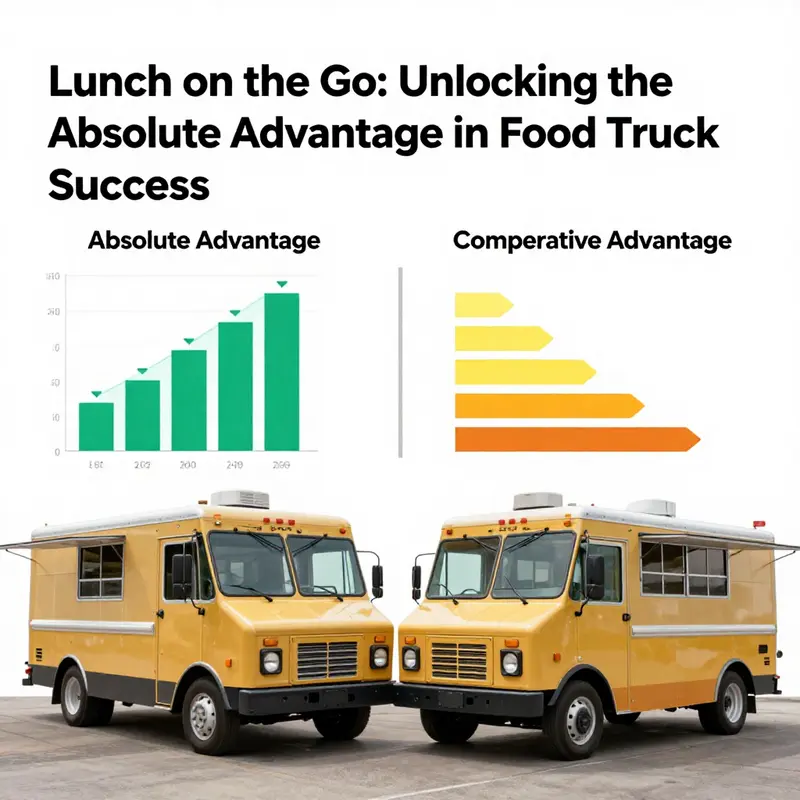
The notion of absolute advantage sits at the heart of how we judge efficiency in production, yet it works best when embedded in a concrete story rather than a long list of abstractions. In the study materials that accompany the quizlet-style review on production economics, absolute advantage is presented through a compact, four-option prompt about different food trucks. The setup is deliberately simple: a single task set, four contenders, and a prompt that asks which truck can perform the task with fewer inputs or, equivalently, at a higher output given the same resources. The design of the card makes the final option stand out as the correct answer, which in turn nudges readers to see how the concept translates into a straightforward measurement: more output per unit of input. But the real value of the exercise goes beyond recalling a specific label. It encourages a reader to translate a card’s digits and labels into a mental model that can guide real life decisions on which truck to operate, how to allocate labor, and where to focus process improvements so that time and resources are used with maximal impact. In that sense, the chapter does not merely test memory; it invites a closer look at what productivity means in a mobile kitchen on wheels and how that productivity is captured in the language of economics. The study materials thus become a bridge between classroom abstraction and street-level operations, a bridge that is essential when you move from the question of which truck has the absolute edge to the broader question of how any business on the sidewalk or the curb can deploy resources most efficiently.
Absolute advantage, in its core definition, is the ability of a producer to generate more output from a given bundle of inputs, or the same output using fewer inputs. In a food-truck context, the inputs could be time, labor hours, or even the quantity of ingredients used per shift. If one truck consistently serves more meals in an hour than the others, or uses less labor to deliver the same number of meals, that truck holds an absolute advantage in the literal sense of productive efficiency. The quizlet example, with four different truck options, is a clean demonstration of this idea. It foregrounds a single product line — meals or snacks offered by a mobile kitchen — and it sets a stage where the resource constraints are clear: the kitchen staff, the cooking equipment, the space on the street, and the time window of operation. When one option outperforms the others under these shared constraints, it earns the label of absolute advantage. This framing helps isolate the driver of efficiency: it is not about taste, brand, or menu variety in the abstract; it is about how well a given configuration translates inputs into outputs, given the same demand and the same working hours.
In the specific flashcard setup, the correct choice is the option listed last. This detail, while seemingly procedural, highlights an important point about how educational tools convey logic. The final option being marked as correct signals that the card designer intends learners to recognize the concluding entry as the one that best demonstrates higher productivity under the same resource constraints. Yet the real takeaway is not the ordering of answers, but the principle that absolute advantage arises from higher output per unit of resource use. The exercise thus becomes a practice in reading data for efficiency: looking at a set of competing producers, one should identify the one that delivers more meals per shift with the same crew and equipment, or that requires less time to complete a standard set of orders. This is a reminder that the concept is a measurement, not a label you attach by instinct. If you were to translate the card into a live scenario, you would gather data on hours worked, meals produced, and resources consumed, then compute output per labor hour, or output per dollar spent on inputs. A sharper picture emerges when you compare apples to apples — the same menu, the same meter of operating time, the same weather and customer demand context — so that the metric reflects differences in process efficiency rather than differences in product offering.
The hypothesis that a particular truck has absolute advantage rests on two essential conditions: identical or comparable output categories and equal resource constraints. In practice, these conditions are rarely perfectly met. Menus can vary in complexity, some trucks may have faster burners, others may rely on a more efficient prep station, and the pace of service can be influenced by the layout of the serving area or the cadence of cashiers. Still, the core logic holds: if, under a controlled comparison, one truck uses fewer inputs to produce the same amount of output, or produces more output with the same inputs, that truck stands as the authoritative example of absolute advantage in that micro-scenario. The quizlet exercise invites this disciplined comparison, nudging readers to think beyond the card’s surface and toward the process that makes one operation superior in efficiency. It is a reminder that in a world of mobile eateries, the best move is often to maximize throughput while minimizing resource waste, a balance that is at the core of effective street commerce.
As this chapter moves from the classroom to the real world, it becomes clear that absolute advantage is only part of the story. If one truck is the most productive with the given inputs, another principle, comparative advantage, remains crucial for understanding how a market or a cooperative arrangement might still benefit from specialization. Comparative advantage asks not who is best at everything, but who is best at producing a particular item relative to others, given their relative efficiencies across all tasks. In a food-truck ecosystem where some trucks excel at speed, others at menu breadth, and still others at capital-intensive cooking techniques, a collaboration or rotation strategy can yield higher total welfare than a single, dominant performer could achieve alone. This is where the quizlet case study becomes more than a memory aid. It becomes a prompt to think about optimization across multiple dimensions: time, labor, menu variety, and customer wait experience. When one evaluates the conditions under which a food-truck operation would benefit from specialization, expansion, or even temporary partnerships with other mobile vendors, the ideas of absolute and comparative advantage provide a robust analytic framework. The upshot is that a single card in a study deck can spark a broader reflection on how to allocate resources most efficiently in a dynamic street-food marketplace.
One practical consequence for operators and planners is to translate these economic ideas into actionable data collection. If you want to determine which truck configuration truly holds the absolute advantage, start by standardizing the task that you measure. Use a consistent menu item or a fixed set of orders, enforce the same operating hours, and ensure the same preparation process is used for all contenders. Record output in measurable units, such as meals served per hour or orders fulfilled per shift, and track input costs or labor hours in the same time frame. Then compare the ratios: meals per labor hour, meals per dollar in input costs, or any other relevant benchmark. The pattern you uncover will reveal whether a particular truck is more productive in a given context then the others, and you can then assess whether the result is robust across different demand scenarios, weather conditions, and customer flow. The beauty of this approach is that it keeps the discussion tethered to actual operations rather than becoming a purely theoretical exercise. It also helps explain why a study resource or a classroom card can be deeply informative: it trains you to ask the right questions about efficiency, to avoid superficial conclusions, and to approximate real-world decision-making where data quality and measurement choices matter as much as the numbers themselves.
To readers who want to explore the topic further through a practical lens that ties directly into planning and modeling, there is value in examining how to choose the right equipment, layout, and staffing to maximize throughput. A deeper dive into the mechanics of choosing the right food truck model can be found in the detailed guidance that accompanies this article series. This resource offers a structured way to think about constraints, capacities, and the interplay between different design choices. It underscores that the path to efficiency is not a single, one-size-fits-all answer but a reasoned process of aligning capabilities with the tasks that drive value for customers. For readers who are curious to see how these ideas translate into a real-world plan, exploring the linked discussion about truck models can provide a concrete map for evaluating options and calibrating expectations with reliability and precision. Choosing the right food truck model helps anchor theory in practice, reminding us that structure and measurement are the most reliable guides to improving throughput and lowering resource waste.
As the chapter concludes its close reading of a quizlet case, the most important takeaway is not merely which truck earns the absolute advantage label, but how the label is earned through careful measurement and disciplined comparison. The exercise foregrounds a foundational economic principle while also illustrating a path from abstract reasoning to tactical decision-making. It invites readers to treat each data point as a potential lever for improvement, to seek consistency in measurement, and to remain mindful of how demand, time, and capacity shape the ultimate conclusion. In the fast-moving world of food trucks, where every minute can translate into additional revenue or lost customers, the capacity to identify and act on absolute efficiency becomes a competitive edge. Yet it remains essential to test such conclusions against the broader context of comparative advantage, to recognize that collaboration, specialization, or changes in menu scope can reshape who is best at what, and under which conditions. The shared thread through all of this is a practical, data-driven approach to evaluating production and operations on wheels — one that begins with a clear concept, moves through careful measurement, and ends with informed decisions about how best to deploy resources for maximum customer value.
External reading can extend this foundation. For readers seeking a concise primer on the ideas behind absolute versus comparative advantage, an external resource provides a clear, accessible entry point that complements the classroom-style flashcards. This resource offers a compact explanation of the core ideas, along with examples that echo the food-truck scenario discussed here. It is a useful companion for readers who want to see how the formal definitions translate into everyday choices on the curb and how the same concepts apply across different kinds of production environments. See the external reference for a quick, structured refresher on the theory that underpins the quizlet example and its practical implications: https://quizlet.com/459207367/econ-unit-8-test-review-flashcards/.
For readers who plan to pursue this topic in more depth within this article, the discussion also connects to the more detailed exploration of model selection in the food-truck context. The internal guidance on choosing the right equipment and layout emphasizes the importance of aligning operational design with the tasks that customers value most. It provides a practical complement to the theoretical framing offered here, helping to turn the concept of absolute advantage into a concrete plan of action for a real-world food truck operation. By integrating the notions of productivity, resource use, and strategic collaboration, this chapter aims to equip readers with a robust, usable framework for assessing efficiency on wheels, while also preparing them to interpret future case studies with a critical eye. The blend of theory and practice invites ongoing experimentation, data collection, and thoughtful interpretation that can inform better decisions in the ever-changing street-food landscape.
Wheels of Advantage: Decoding Absolute and Comparative Gains in a Two-Truck Menu
The question “which food truck has the absolute advantage?” sits at the intersection of everyday cooking and market theory. In practical terms, it asks: when two trucks produce a simple, two-item menu, which one can make more of each item with the same inputs? That is the heart of absolute advantage. Yet the real force behind what happens when both trucks cook, wrap, and serve under the same constraints lies not only in who is faster at each dish, but in how the opportunity costs line up. When we think through a two-truck, two-item scenario—say burritos and tacos—we begin to see how production choices ripple through supply decisions, pricing, and customer satisfaction. The material you encounter in study aids and classroom reviews often frames it with a straightforward conclusion: one truck might dominate the other on every item. But the practical takeaway runs deeper. Absolute advantage signals where a truck could produce more in total, given equal resources. Comparative advantage, by contrast, guides how to allocate effort when trade or collaboration could improve overall welfare, even if one party seems stronger in every dimension.
Imagine two trucks, Truck A and Truck B, each capable of making burritos and tacos. They share the same kitchen footprint, the same number of staff, and roughly the same access to ingredients. Absolute advantage, in its cleanest form, looks at output rates: if Truck A can produce more burritos per hour and more tacos per hour than Truck B, then A holds the absolute advantage in both goods. If A outpaces B on burritos but not on tacos, or vice versa, the picture shifts. The choice a business owner makes then is not only about raw speed; it is about how best to deploy the scarce resources to maximize total production and meet demand in the market. In a real-world context, this framing helps managers decide who should focus on which item, or whether joint operation of duties would yield higher overall output.
To translate this into workable logic, we can walk through a few illustrative scenarios. In the simplest case, Truck A’s rates exceed Truck B’s for both burritos and tacos. For example, A might produce 12 burritos per hour and 6 tacos per hour, while B makes 8 burritos per hour and 4 tacos per hour. Here, A has the absolute advantage in both goods. The intuitive takeaway is straightforward: if you want more of both items from the same investment of time and labor, assign more of the shared capacity to Truck A. This scenario is easy to grasp but rarely the whole story. Markets rarely present symmetrical advantages across every good, and many real-world setups hinge on trade-offs that go beyond sheer output.
A second, subtler scenario occurs when one truck outperforms the other on one item but not on the other. Suppose A still makes burritos at 12 per hour but tacos lag behind B’s rate of 10 tacos per hour, with B producing burritos at 8 per hour. In this case, A has the absolute advantage in burritos, while B holds the edge in tacos. The capacity decision becomes a question of specialization: should A lean toward burritos and B toward tacos? The strategic implications ripple outward—menu design, pricing, and even customer flow in the serving queue can hinge on such assignments. A well-choreographed division of labor can raise total output more effectively than a uniform approach that treats every item as equally important for both trucks.
A third scenario, perhaps the most common in practice, occurs when neither truck dominates in both goods. Imagine A at 12 burritos and 6 tacos per hour, and B at 8 burritos and 10 tacos per hour. Here, neither truck has absolute advantage in both items. A produces more burritos, but B produces more tacos. The absence of a single winner forces a different kind of thinking. If your goal is to maximize combined output, you may want to assign burrito production to A and tacos to B, or you might explore a hybrid schedule that balances peak times for each item. In any case, the absence of a clean, one-size-fits-all winner underscores a vital point: absolute advantage matters, but it does not automatically dictate the best production plan once demand, costs, and logistics come into play.
This is where the broader lesson becomes important. Even when a truck holds the absolute advantage for both goods, there can still be gains from trade if the opportunity costs differ. Opportunity cost captures what you sacrifice to produce one more unit of something else. If Truck A has a lower opportunity cost for burritos, and Truck B has a lower opportunity cost for tacos, then specialization followed by cooperation can yield higher total output for both. The intuition is simple: when every unit of scarce resource spent on burritos costs fewer tacos for one truck and fewer burritos for the other, trading what each truck gives up in order to specialize becomes mutually beneficial.
To bring this to life with numbers, consider three illustrative setups. In the first setup, Truck A produces burritos at 12 units per hour and tacos at 6 units per hour, while Truck B produces burritos at 8 and tacos at 4. A clearly dominates both goods, but the opportunity costs are identical: the sacrifice of tacos per burrito is 0.5 for both trucks, and the sacrifice of burritos per taco is 2 for both. There is no comparative advantage to exploit here, and the gains from trade are limited unless other frictions disappear or demand shifts in a way that makes cooperation strategically valuable.
A second setup tweaks the rates so that A maintains burrito leadership but B flips the taco advantage. Suppose A = 12 burritos/hour and 6 tacos/hour, while B = 8 burritos/hour and 10 tacos/hour. A has the absolute advantage in burritos, while B has it in tacos. The logic of specialization arises: allocate burrito production to the truck with the higher burrito rate and tacos production to the other with the higher taco rate. The market then benefits from a greater total output that meets customer preferences efficiently, rather than forcing one truck to chase both items under the same constraints.
A final setup, more stark in its economics, keeps both trucks in the race for both goods but with a twist in opportunity costs. Let A produce 12 burritos and 6 tacos, and B produce 8 burritos and 10 tacos. A’s opportunity cost for burritos is 2 burritos per taco (12 burritos foregone divided by 6 tacos produced), while B’s is 0.8 burritos per taco (8 burritos foregone divided by 10 tacos). For tacos, A’s cost is 0.5 tacos per burrito (6 tacos foregone divided by 12 burritos), while B’s is 0.8 burritos per taco. In this arrangement, B has the comparative advantage in tacos, and A has the comparative advantage in burritos. Even though A might dominate on burritos alone, the gains from trade emerge precisely because their relative costs diverge. Specialization aligned with comparative advantage can unlock efficiency that absolute advantage alone cannot guarantee.
Practically, these patterns translate into concrete decisions for a mobile food operation. If demand trends show customers craving burritos after a busy lunch hour, you might want to allocate more resources to the truck with the better burrito throughput. If tacos are the evening crowd-pleaser, shifting focus toward the taco workflow can maximize overall productivity. The key is to map where each truck excels and where it lags, not to default to a single, “best” profile for every item. This emphasis on relative efficiency—what one truck sacrifices to produce more of a given item—helps managers decide which items to push at different times, whether to rotate duties, and how to staff the kitchen to minimize idle time.
Beyond the arithmetic, real-world frictions shape the optimal arrangement. Demand variability, ingredient costs, and inventory constraints matter as much as the raw rates. Transportation between stations, quality control, and the need to maintain a consistent customer experience across a menu can all limit or enable specialization. In practice, a production-orientation approach serves as a decision framework: list each item, capture output rates for each truck, calculate the opportunity costs, and then consider how to allocate tasks over the course of a day or week. The goal is not to prove one truck is the indisputable winner in every dimension, but to understand how to deploy capabilities so that the total output can respond to demand with agility while keeping costs in check.
As you move from theory to practice, you will also encounter a broader set of tools. Production possibilities frontiers, or simple visualizations of trade-offs, can help teams see how shifting focus on one item affects the other. In a two-truck world, the PPF is a compact map of potential outputs under given constraints. It clarifies whether a given specialization plan would yield more total production than a uniform, one-size-fits-all approach. The visual clarity can be especially valuable in high-traffic settings where decisions must be made quickly and with limited information. More broadly, this framework supports a disciplined routine: periodically reassess output rates, rebalance tasks as demand changes, and adapt to technology upgrades, training, or changes in ingredient prices. Such recalibration ensures that the gains from any chosen specialization are preserved over time, even as the market and costs evolve.
For practitioners who want to connect theory to practice, the path is not merely to memorize a rule about absolute advantage. It is to build a production system that listens to capacity and demand, then aligns menu choices with those dynamics. The discipline of measuring output, tracking opportunity costs, and testing different allocation schemes becomes a core competency. It shapes everyday decisions—from who cleans the kitchen after service to how you pair a menu with a street-foot traffic pattern to maximize exposure—and it anchors strategic planning during slow seasons. In short, understanding absolute and comparative advantage provides a lens through which to view both menu design and staffing logistics, turning abstract concepts into actionable routines that improve efficiency and customer satisfaction.
For readers seeking a succinct primer and practical problem sets that mirror the classic “Which food truck has the absolute advantage?” style, a well-known study resource offers a compact, educational framework. It reinforces the idea that absolute advantage is about greater output with the same inputs, while comparative advantage hinges on relative costs and potential gains from specialization. While the exact examples from any single study aid can differ, the underlying logic remains consistent: measure, compare, and align production with where each truck can contribute most effectively. This perspective not only clarifies a hypothetical classroom question but also illuminates the decisions a real-world food operation faces when balancing multiple dishes and shared production space.
If you want to explore this topic further in a guided, problem-driven way, you can consult practice materials that frame the concept in a two-item, two-truck context. Internal discussions about which item to emphasize at what time can be informed by the same logic that helps economists determine opportunity costs and potential gains from trade. As you integrate these ideas into your own workflow, you may find that the chapter on choosing the right equipment and layout—emphasized in guides about selecting the right model for your truck—offers practical pathways to implement a strategically informed production plan. This integration helps bridge the gap between theory and day-to-day decisions on wheels.
For additional context and problem sets that mirror these ideas, you can refer to the external resource that presents the principles in a concise, study-friendly format. It serves as a useful companion to the exploration of absolute and comparative advantage in a mobile food context and can help sharpen your intuition about when holding the line on a single approach is optimal and when diversification through specialization yields superior results.
External resource for further reading: https://quizlet.com/459207367/econ-unit-8-test-review-flashcards/
Internal link to related guidance: To connect these ideas with practical planning, see the discussion on Choosing the right food-truck-model, which outlines how to align production capabilities with market demand in a live, busy kitchen setting. https://loschifladostruck.com/choosing-the-right-food-truck-model/
Final thoughts
Understanding which food truck holds the absolute advantage, and why, offers far-reaching insights for both the culinary street scene and the business of mobile food service. Quizlet’s example of ‘Lunch on the Go’ demonstrates that maximizing efficiency while maintaining appeal is essential in gaining a competitive edge. Whether you’re scouting vendors for an event, growing your own food truck operations, or simply exploring the economics behind your favorite street eats, knowing how absolute advantage operates helps you make better, more strategic choices.