
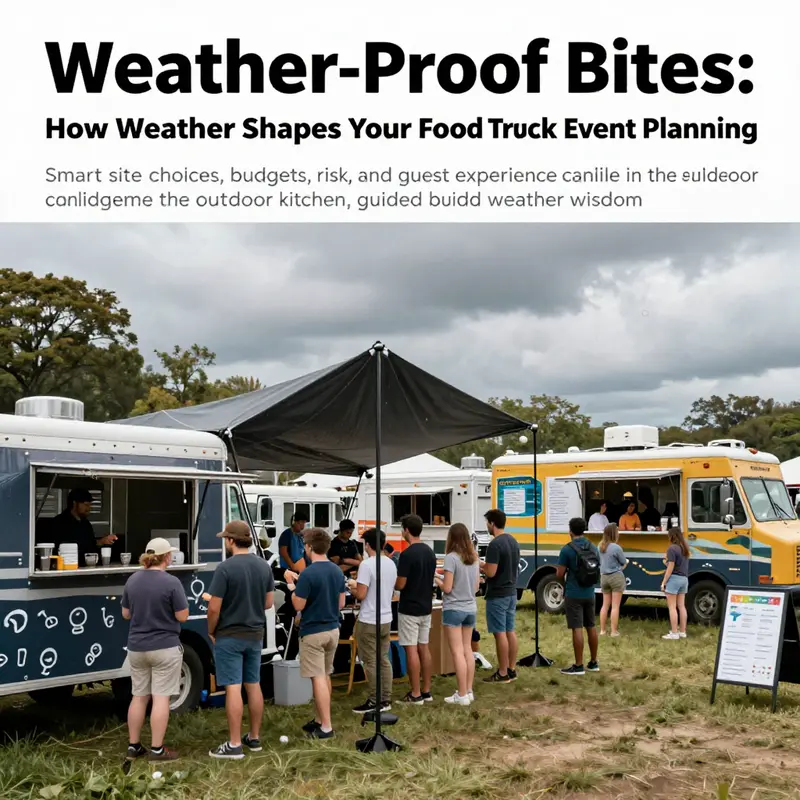
Outdoor food-truck events live and breathe with the weather. A bright, comfortable afternoon can turn into a bustling rush; a sudden shower can test your layouts, staffing, and safety measures. For event planners, corporate teams, community groups, and food enthusiasts, weather isn’t a backdrop—it’s a co-pilot that reshapes site selection, timing, and operations. By understanding how forecast trends translate into real-world actions, you can design resilient plans that protect guests, staff, and the bottom line. This piece weaves three interconnected chapters into a holistic view: Chapter 1 focuses on Site Selection, Scheduling, and Operational Layout; Chapter 2 dives into Financial Implications, Inventory Management, and Staffing; Chapter 3 examines Risk Management, Contingency Planning, and Communication. Together, they form a practical playbook for weather-aware planning that keeps events thriving—rain or shine, heat or gusts—while delivering a memorable, safe experience for all involved.
Weather as Compass: Site Selection, Scheduling, and Operational Layout for Outdoor Food-Truck Events
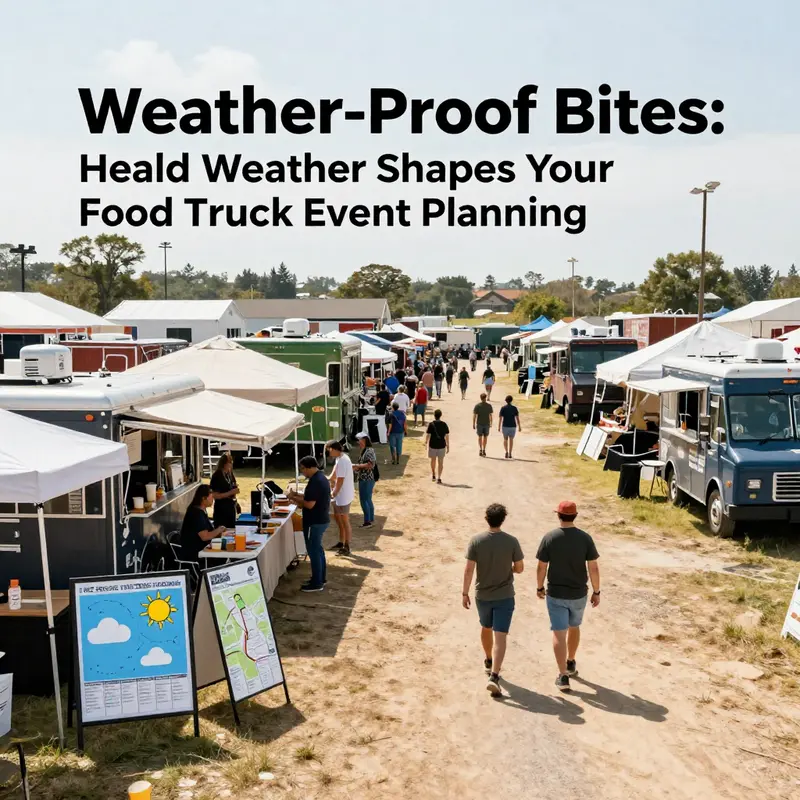
Weather is a critical driver for outdoor food-truck events. It shapes where trucks can operate, when crowds appear, and how teams move, serve, and protect guests. Mild temperatures and daylight can boost foot traffic, while rain, heat, or strong winds can disrupt operations. A weather-informed approach embeds forecasts into site selection, event scheduling, and the physical layout. Site selection benefits from a reliable weather profile, drainage, shade, water, and power considerations. Shade and shelter reduce heat stress and protect product quality, while wind considerations influence canopy design and ballast. The operational layout should be modular and adaptable to evolving conditions, emphasizing shade, hydration, windbreaks, and clearly defined queues. Scheduling balances fixed event dates with forecast windows, using thresholds (probability of rain, wind speed, heat index) to trigger contingencies like rescheduling, relocation, or closure. Communication is essential: signage, staff briefings, and weather roles help align the team and guests. The financial picture includes potential up-front costs for shelter, ground protection, power, and contingency staffing, offset by more reliable attendance and guest satisfaction. A data-informed workflow—combining historical norms with current forecasts—lets operators plan with confidence while retaining agility and safety.
Forecasts as Margin Mapping: Weather-Driven Finance, Inventory, and Staffing for Food Truck Events
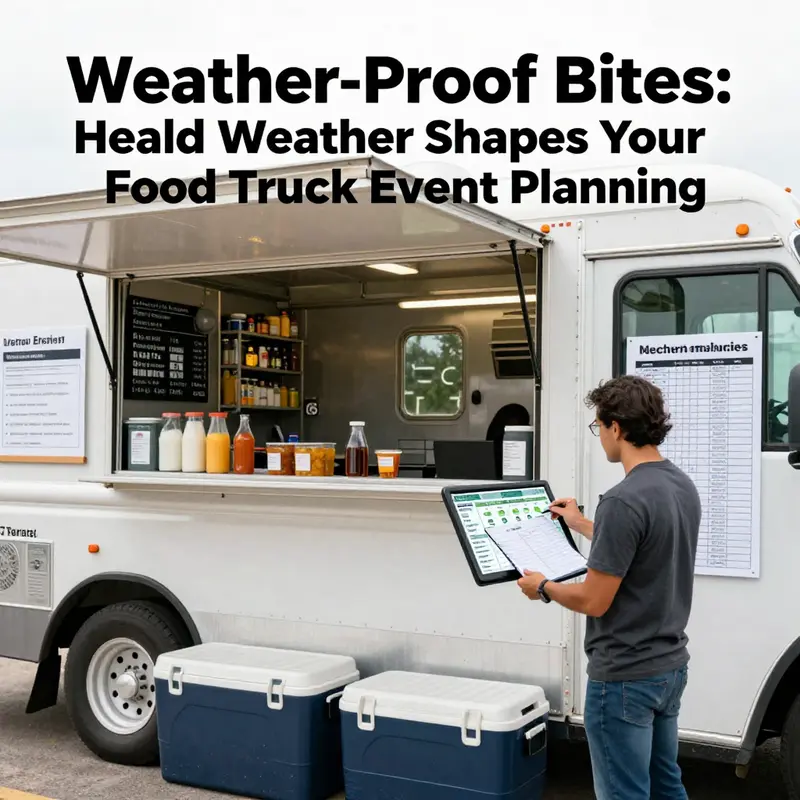
Weather is not just a backdrop for outdoor dining; it is a live factor that maps directly to margins. For a food truck operating at street fairs, markets, and private gatherings, the weather you wake up to is as influential as the customer queue you see at lunch. It shifts demand, alters what you can serve efficiently, and reshapes the costs you carry. When a sudden shower moves the crowd indoors, or a heat wave drives people to shaded corners for hydration, the consequences cascade through the financial plan, the stock you carry, and the people you deploy. To plan effectively, operators must knit weather awareness into three interconnected veins: finance, inventory, and staffing. The goal is not to predict weather with perfect accuracy but to anticipate how weather shifts behavior, costs, and service quality, and to embed safeguards that preserve profitability even when conditions become less favorable. This integration demands a disciplined approach to forecasting, a flexible supply chain, and a workforce that can pivot quickly without sacrificing safety or customer satisfaction. In practice, it means treating forecasts as margin maps: they show where revenue is likely to expand or contract, where waste may occur, and where labor must stretch or retreat to maintain a steady service standard.
The path from forecast to margin starts with recognizing how different meteorological conditions translate into business outcomes. Rain or thunderstorms compress foot traffic, encourage quick, shelter-seeking turnovers, and lift the importance of comforting, fast-to-serve items and beverages. The pricing and menu logic may tilt toward items with shorter cooking times and reliable yields, while promotions can be timed to align with sheltered windows when the outdoors is less accessible. Extreme heat has the opposite effect: it can slow the pace of service if staff must pause for hydration and breaks, but it can also lift demand for cold drinks and ice-based treats that provide higher ticket values per guest. Cold weather tends to shorten dwell time in some markets, yet hot items rise in popularity as patrons seek warmth from the inside out. Wind and storms complicate setups, emphasizing wind-rated canopies, secure anchoring, and careful planning of venting so that smoke and odors do not intrude on guests. Humidity and air quality alter both kitchen dynamics and guest comfort, sometimes shortening service windows when outdoor air becomes oppressive or triggering safety and health protocols that demand shorter exposure in crowds. Seasonal patterns, even when volatile in the moment, deliver predictable cycles that a well-prepared operator can exploit through flexible staffing, adaptive inventory strategies, and insurance planning that recognizes the probability of disruption.
To translate weather into reliable planning, a business must marry data with discipline. Forecasting is not a single event; it is a continuum that spans 7–14 days and tightens to 24–72 hours before service. In this continuum, thresholds and triggers become the anchor for decisive action. A forecast probability above a defined threshold for rain may initiate a formal rain plan: relocate to a covered site when permitted, reduce canopy footprint, reinforce ground protection, and adjust queue management to minimize slip hazards. A forecasted heat index above a safe limit triggers a heat-area strategy: extend shaded zones, deploy misting or ventilation where appropriate, and adjust the menu to emphasize items with shorter hold times and higher margin per unit. Wind thresholds guide how much canopy you can safely deploy and where to position exhausts and customers to keep airflows pleasant and safe. The overarching aim is to preserve a smooth flow of guests and a clean, safe operation while maintaining a viable margin even when weather suppresses attendance.
From there, the financial implications unfold in three linked streams: revenue, costs, and cash flow. Revenue volatility is the most immediate consequence of unpredictable weather. A rainy day or an abrupt cold spell may shrink foot traffic and lead to a disproportionate drop in impulse purchases. Prepared operators convert this risk into resilience by building a weather contingency line in the budget, a share of capital that covers faster pivots, last-minute instrumented changes to inventory, or even relocation and rescheduling when supported by the event organizer. Insurance considerations sit alongside these measures, with policies that cover event cancellation, equipment damage, and business interruption offering a cushion when the weather disrupts planned attendance. Yet insurance is not a substitute for proactive contingency planning; it should complement, not replace, the operational safeguards that protect margins.
Inventory management sits at the heart of weather-aware financial resilience. Weather dictates what is likely to sell and when. Rain reduces outdoor dwell time and shifts demand toward grab-and-go formats and warm beverages, while heat pulls guests toward cold drinks, lighter snacks, and faster service. Perishables carry higher risk when weather dampens turnout, so the ordering strategy must be forecast-driven, integrating short-term weather projections with historical sales data. The emphasis is on flexible supplier arrangements, so last-minute adjustments in quantities do not trigger waste or spoilage. Cold-chain integrity becomes non-negotiable on hot days; monitoring temperatures, ensuring robust refrigeration, and preparing contingency storage arrangements if a chosen site experiences power disruptions are essential. Menu engineering becomes a strategic tool: maintain a stable core lineup that travels well across weather scenarios, while keeping a set of adaptable add-ons or daily specials that respond quickly to forecasted demand. In such an environment, the line between inventory and pricing blurs, because weather-related shifts in demand may justify time-limited promotions or price incentives designed to smooth demand across a broader window of the day. Waste dashboards, real-time inventory tracking, and proactive communication with suppliers help identify over-ordering early and enable rapid course corrections for subsequent events.
Staffing and labor management are the human counterpart to the weather-driven financial and inventory plan. Forecast-driven scheduling means aligning labor hours with anticipated demand, which varies with weather. On rainier days, you may rely on fewer front-of-house staff engaged in queue management and safety oversight, while ensuring kitchen throughput remains steady for the items that travel best in wet weather. When the forecast promises heat, you balance hydration monitoring, cooling breaks, and additional staff to handle slower but steadier demand during peak heat windows. In cold conditions, wind breaks and heated zones can extend dwell time, but you may need different staffing configurations to manage longer prep cycles and turnover turnover that is slower in cold weather. Training emphasizes cross-function versatility, enabling cooks, facilitators, and order-takers to swap roles as demand shifts. Safety becomes a central priority: weather-related protocols, heat illness prevention, cold exposure mitigation, and rain safety all require explicit guidance and practice so the team can respond without hesitation.
A data-driven mindset completes the triad of finance, inventory, and staffing. Weather data must feed a model that couples forecasted conditions with sales velocity, average ticket size, and inventory burn. The best operators build scenarios that reflect best, typical, and worst-case weather outcomes, then map those scenarios to staffing levels, inventory purchases, and financial buffers. Real-time dashboards track weather alerts, guest flow proxies, inventory status, and labor utilization, while communication channels ensure staff, customers, and partners are informed of changes swiftly and clearly. The goal is not to eliminate uncertainty but to reduce its impact on margins by making weather a controllable variable rather than a random disruptor. In practice, this means three things: a reliable forecast feed that matches your event calendar, a flexible procurement and labor strategy that can scale up or down quickly, and a governance routine that revisits assumptions after each event to tighten the model for the next one.
Operational readiness for weather is inseparable from a disciplined contingency framework. Thresholds and go/no-go criteria formalize the moments when service should adapt, relocate, or pause. Backup sites and relocations are not accidental but pre-arranged, with access, power, water, permits, and staffing in place well before the event starts. A communication playbook ensures guests and staff understand what is happening and why, reducing confusion and protecting the guest experience. Partnerships with other vendors or venues can unlock weather-protected space that would be inaccessible to a single operator, widening the options when the forecast is unfavorable. Finally, after-action reviews close the loop: they compare forecasted weather with actual attendance, analyze inventory waste and labor efficiency, and record the decision timelines that proved effective. The learnings feed the next cycle, creating a weather-aware business that does not merely survive harsh conditions but uses them to optimize margins over time.
The practical tools that support this discipline are as important as the concepts themselves. A weather-driven planning checklist helps teams stay aligned from pre-event to post-event activities. An inventory adjustment template nudges planners to translate forecast adjustments into concrete buy decisions. A staffing plan aligns shifts with expected demand while preserving safety and morale. A decision-rule matrix translates weather cues into actionable steps, reducing cognitive load during moments of stress. These templates are designed to be editable so that they evolve with experience and with the particular rhythms of a city, a market, or a festival. They are not ends in themselves but scaffolds that support disciplined judgment when weather is a foreground risk rather than a distant consideration.
To bring these ideas to life, consider a few illustrative moments drawn from typical event conditions. On a clear, sunny morning with a moderate breeze, the plan tends toward standard operations: the core menu remains the backbone, stock levels reflect a comfortable forecast, and staffing mirrors the expected turnout. If a sudden front of rain approaches with moderate confidence, the weather plan triggers a tightened canopy strategy, a sheltered customer path, and a temporary shift toward fast-serve items that minimize exposure for both guests and staff. The forecast might call for a longer window of rain with peak periods shifting, so the team re-allocates staff to handle the updated peak predictably and safely. In the heat of a summer afternoon, the plan shifts again: extra cooling, shade, and hydration convert some of the crowd behavior into extended dwell time in a controlled area, while inventory leans toward cold beverages and light snacks with higher margin contribution. If gusty wind arrives, the wind plan activates appropriate ballast and a reduced canopy footprint, with venting carefully managed so smoke and odors remain comfortable and safe for guests. Through each shift, the financial lens remains visible: the team recalculates expected revenue under the new conditions, weighs the cost of contingencies, and tracks how quickly the actuals align with the forecasted scenario.
The chapter would be incomplete without acknowledging the support of practical, city-specific knowledge. Weather patterns in one locale may follow a rhythm quite different from another, and the interplay of heat, humidity, and wind can be amplified by urban canyons, topography, and local airflow. The disciplined approach presented here is designed to travel with you. It does not require heavy new software or exotic gear; it requires a mindset that weather is a controllable part of the business, a factor that, when managed well, can stabilize margins rather than erode them. The mindset also invites collaboration. It invites partnerships with event organizers to align schedules with better weather windows, with suppliers who can offer flexible purchasing terms, and with other vendors who can share protected spaces during adverse conditions. It invites staff to take ownership of weather-related safety and efficiency, turning what could be a disruption into a disciplined practice of resilience.
For operators exploring the broader context of weather resilience and market uncertainty in food-truck ventures, this emphasis on forecast-informed finance, inventory adaptability, and agile staffing resonates with the larger body of work on resilience in volatile markets. See the linked discussion on food-truck resilience and market uncertainty for a complementary perspective that extends beyond a single event and into continuous, adaptive operation. food-truck resilience and market uncertainty
As a final note, consider the external resource that frames climate-related health and safety considerations within planning. Understanding how heat, cold, and air quality affect guest and staff well-being adds a crucial layer to the risk assessment and decision rules you implement for every event. External resource: https://www.who.int/news-room/fact-sheets/detail/climate-change-and-health
The weather data you collect, the inventory you plan to hold, and the staff you train all feed a single objective: to preserve service quality and profitability across a wide weather range. When weather is treated as a margin map rather than a nuisance, food trucks can plan with confidence, adapt with speed, and serve guests consistently, even when the forecast holds surprises. The discipline of weather-aware planning is not a one-time exercise but an ongoing refinement of forecast-driven decisions that keeps margins intact while preserving the guest experience across the seasons.
Weather as a Co-Chef: Integrated Risk Management, Contingency Planning, and Communication for Food Truck Event Success
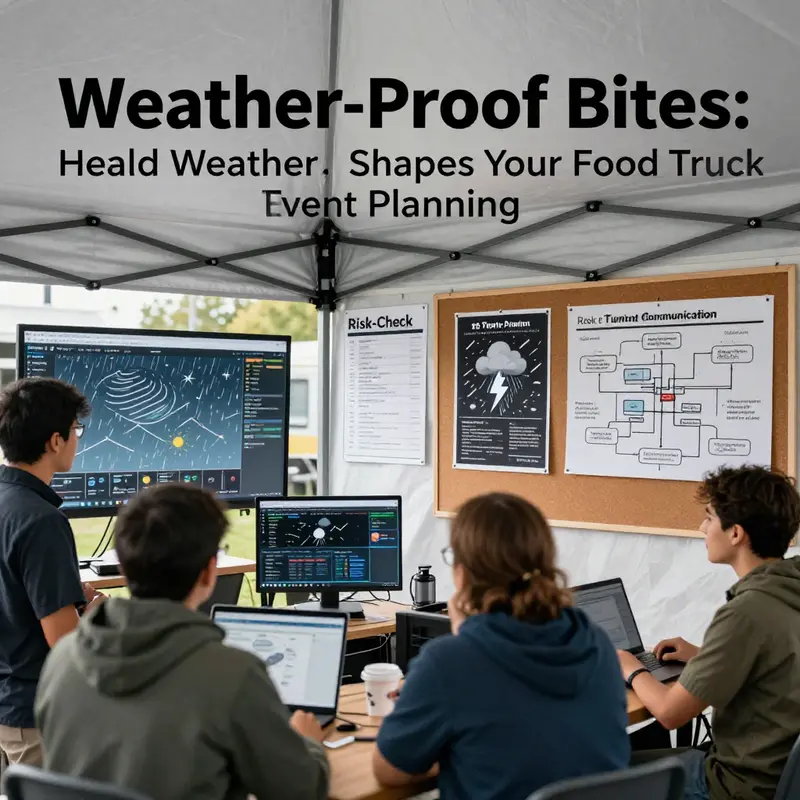
Weather does not merely accompany outdoor food-truck events; it co-authors them. It writes the opening, shapes the menu, and determines the pace of service. In the bustle of a festival, a market, or a private gathering, a thoughtful operator treats meteorological conditions as a dynamic, integral partner in risk management. The goal is not to chase perfect weather but to choreograph a performance that remains sturdy, flexible, and inviting regardless of what the sky might deliver. That requires a single, cohesive approach that blends risk assessment, structured contingency planning, and precise, customer- and staff-facing communication. When weather becomes a constant consideration woven into daily decisions, the result is a more reliable operation, steadier revenue, and a safer, more comfortable experience for guests. In practice, this means moving beyond ad hoc adjustments and toward a deliberate, data-informed framework that travels with the event, adapts to conditions on the ground, and preserves diner delight even on less forgiving days.
The terrain of weather-related risk for food trucks is broad, spanning precipitation, temperature extremes, wind, humidity, air quality, storms, and the slow burn of seasonal patterns. Rain reshapes not only customer turnout but the very surface on which people stand and the way power and water lines are laid out. A sudden downpour can drain queues, soak footwear, and demand rapid deployment of waterproof canopies and ground protection. The same rain can push guests into sheltered spaces, intensifying crowding in limited areas and challenging traffic flow. Thunderstorms introduce a sharpened risk calculus: lightning safety, the potential for power outages, and the need for rapid evacuation plans that keep staff and patrons out of harm’s way. Wind does not merely ruffle banners; it tests the integrity of tents, the stability of signage, and the trajectory of smoke or steam from cooking operations. A gusty afternoon can turn a well-planned footprint into a maze of wind corridors that complicate movement, elevate the risk of slips, and require agnostic space reallocation and cautious tent management.
Extreme heat poses multiple layers of challenge. It affects guest comfort, which in turn drives dwell time and order volume. It also heightens food safety concerns when hot-held items linger near the edge of acceptable temperatures or when cooling and ventilation systems are overtaxed. In cold conditions, the challenge shifts toward maintaining staff comfort while ensuring that cold-chain integrity remains intact and beverages do not freeze in storage or during transport. Humidity compounds these issues by altering crust formation on fried items, affecting cooking times, and amplifying the sense of discomfort for guests. Air quality adds a more intangible dimension: wildfire smoke, urban pollution, or seasonal pollen can shrink outdoor dwell time and trigger health-driven contingency actions. When air quality deteriorates, operators may need to shorten service windows, switch to less strenuous cooking methods, or enhance enclosed cooking areas with better ventilation.
Storms and weather alerts operate with almost surgical precision in outdoor settings. A thunderstorm can arrive with little notice and carries safety implications that supersede all other concerns. A robust plan demands a weather-monitoring discipline, clearly defined evacuation routes, a predictable sequence for securing equipment, and the ability to pause service without fracturing the guest experience. Seasonal patterns further complicate planning by introducing predictable constraints. Monsoon cycles, heat waves, and recurring wind corridors shape when and where foot traffic is likely to concentrate, how long a queue tends to stretch, and when backup dates or indoor backups become financially prudent. The interplay between location and season matters, too. A site with good drainage and partial cover can mitigate rainfall risks, while a venue adjacent to a body of water or in an urban canyon may experience amplified wind or microclimates that alter comfort levels, staffing needs, and equipment performance.
To navigate this landscape, a disciplined framework of data, thresholds, and governance is indispensable. The first pillar is data-driven forecasting. Operators should consult government meteorological services and trusted commercial feeds for planning horizons ranging from days to hours. The practice involves establishing forecast watch windows—long enough to prepare but short enough to stay responsive. Thresholds translate forecasts into concrete actions: a rain probability above a defined threshold might trigger additional ground protection and revised queue layouts; a wind forecast exceeding a safe limit could prompt checks on tent anchorage and adjustments to canopy footprint; a heat index surpassing a safe level may trigger shade expansion, hydration protocols, and altered service times. A weather lead or safety lead should own this translation from forecast to action, with a clear line of communication to the rest of the team. The aim is to ensure that forecasts do not become noise but become actionable signals that steer operations.
The decision-making framework must also recognize that weather is a probabilistic partner. It is rarely binary, so teams should embrace conditional planning rather than rigid plans. A residual approach—planning for Plan A in normal weather, Plan B for moderate disruption, and Plan C for severe disruption—enables graceful adaptation without the chaos of ad hoc improvisation. Plan A could feature standard layouts and typical menus, but even here, the plan anticipates contingencies for brief showers or minor heat surges. Plan B might call for additional shade structures, alternative queuing strategies, shortened hours, and menu adjustments emphasizing items with longer hold times or easier portable packaging. Plan C calls for clear relocation or cancellation protocols, with refunds or credits handled transparently to preserve trust. In this light, contingency planning is not a shield against risk but a skillful choreography that preserves experience by balancing safety, service, and revenue.
Equally critical is the clarity and tone of communication. Weather events demand concise, timely, and consistent messaging across internal teams and to guests. An explicit communications plan defines who speaks, through which channels, and how quickly information radiates when conditions shift. Internally, a staff roster should include a weather lead, a shelter manager, and a communications liaison who can translate weather updates into on-site instructions. Externally, patrons should receive clear, proactive guidance through announcements, app updates, signage, and social channels. The messaging should set expectations about potential delays, sheltered areas, changes to menu or operating hours, and the safety steps guests should follow. A well-structured communication framework reduces confusion, maintains trust, and ensures that guests feel cared for even when plans must change because of the weather.
The interplay between risk management, contingency planning, and communication is not merely theoretical. It translates into concrete, repeatable practices that can be tested and refined. A practical approach starts with a risk register that inventories weather hazards specific to the venue and season, assigns likelihood and impact, and links each hazard to concrete mitigations. The mitigation layer includes physical protections, such as wind-rated canopies and non-slip flooring, as well as operational controls like flexible staffing and staged opening times. Food safety considerations remain central; standardized hold times, temperature monitoring, and rapid sanitation protocols prevent minor weather-induced disruptions from becoming major safety concerns. In parallel, a backup power and water plan ensures core operations survive through interruptions. A weather watch plan couples forecast sources with action triggers and a communication protocol that ensures everyone knows when and how to react. Every component should feed the next, so that data informs decisions, decisions guide actions, and actions create a reliable guest experience regardless of meteorological twists.
The literature on weather-ready operations emphasizes the value of redundancy. Relying on a single power source, a single canopy supplier, or a single forecast provider introduces single-point risk that weather can exploit. Instead, a resilient operator builds multiple data streams, reserve supplies, and alternative site options. Redundancy extends to site design as well. A well-planned footprint anticipates wind corridors and inbound weather shifts by including sheltered zones, clearly defined pedestrian pathways, and drainage-aware layouts that prevent water from pooling near electrical equipment. It also means certifying that every essential equipment piece—refrigeration, hot-holding units, point-of-sale systems—has a contingency path, whether that is a backup unit, battery power, or a temporary relocation to a more secure space.
Staff readiness follows suit. Weather-focused drills, role-specific checklists, and explicit responsibilities minimize confusion during a weather event. A small but powerful practice is to assign a weather lead who inventories, communicates, and synchronizes actions across all roles. The shelter manager maintains the physical safety envelope, ensuring that canopy weights are adequate and that crowd flow remains safe and intuitive. The vendor liaison coordinates power and water, and the communications lead translates forecast-driven decisions into guest-facing messages. This trio, working in concert with the event organizer or site supervisor, creates a resilient system that can adapt in real time while maintaining service quality.
From a financial perspective, the weather calculus is not simply about preventing losses but about preserving opportunities. Weather contingencies carry costs—additional shelter, gear, staffing, and sometimes refunds. Yet without them, revenue volatility and reputational risk can escalate. The most effective approach budgets for contingencies up front and aligns them with clear decision criteria. A formal contract framework with contingency clauses and insurance add-ons helps manage risk with third parties, reducing the friction that might otherwise accompany last-minute changes. Moreover, post-event evaluation that correlates attendance, order volume, and revenue with weather conditions closes the loop. It creates a feedback loop that informs future thresholds, messaging, and logistics, turning weather experience into smarter planning rather than a recurring challenge.
A well-executed weather strategy also acknowledges the social and regulatory environment. Permits, safety codes, and insurance terms increasingly require explicit weather considerations. An operator that integrates these requirements into planning signals a professional, proactive stance that regulatory bodies and venues tend to reward with smoother access to sites and better collaboration during events. Public-safety expectations, accessibility considerations, and heat illness prevention for vulnerable populations further amplify the necessity of a thoughtful approach. Communication with the community about weather contingencies and refunds reduces frustration and helps maintain goodwill when plans shift because of weather. This broader perspective—embracing governance, safety, and community needs—ensures that weather planning is not a narrow risk exercise but a comprehensive, stakeholder-valued strategy.
To translate these principles into practice, consider how the early stages of planning unfold. Begin with a weather-informed site selection and layout design. Choose venues with drainage advantages, shade availability, and access to potable water. Build in redundancy by negotiating backup dates or indoor/semior covered alternatives where feasible. Establish a forecast-driven decision cycle that starts weeks out and tightens as the event approaches. Identify threshold-based triggers that prompt concrete actions and designate owners who will implement those actions. Develop a communications playbook that aligns internal channels with guest-facing updates, and craft ready-to-use messages that staff can deploy without delay when conditions change. Prepare templates for contingency plans, risk registers, and incident reports, and rehearse their use in seasonal drills. Finally, incorporate a deadline-driven post-event review that ties weather outcomes to attendance, sales, and guest feedback, turning weather experience into measurable improvement.
The practical payoff for operators who embed weather into their core planning is substantial. A weather-aware operation reduces the chaos often associated with outdoor events, preserves customer comfort, and sustains service quality even as conditions shift. It enables steadier staff performance by clarifying expectations and providing clear recovery paths. It also strengthens the guest experience by offering defined shelter options, predictable messaging, and transparent policies around refunds or credits when plans must change. The best operators view weather not as an adversary but as a collaborator—one who nudges them toward more thoughtful layouts, more robust equipment, and more compassionate communication. The result is a festival or market experience that remains inviting, efficient, and memorable, regardless of what the sky brings.
For readers seeking a concise path to resilience, consider this practical recommendation: anchor your planning in a simple three-tier threshold system, assign a weather lead to translate forecast data into operational actions, and codify a guest-facing communications plan that remains visible and consistent throughout the event. Integrate your contingencies with a clear plan for refunds or credits to preserve trust. Treat weather drills as routine rather than once-a-season exceptions, and review every event through a post-action lens to refine thresholds and messaging. The more you treat weather as a constant partner, the less it disrupts your operation—and the more your guests feel looked after, regardless of what happens above.
If you are looking to connect this framework to broader industry conversations and resilience-minded practices, you can explore related discussions on food-truck resilience in uncertain markets. This aligns with the same core idea: plan ahead, stay adaptable, and communicate with purpose. food-truck resilience in uncertain markets.
In closing, the weather math is not a single equation but a living system—data, people, space, and safety converging to sustain performance. A robust weather strategy is not a rigid script but a flexible, continuously improving practice. It recognizes that each forecast is a message with meaning for every shift in service, every adjustment in the layout, and every word spoken to a guest. When done well, weather planning becomes a quiet, constant contributor to success, one that elevates the entire event by turning meteorological uncertainty into a disciplined advantage. For operators who commit to this approach, the forecast is less about fear and more about foresight, timing, and thoughtful care for staff and guests alike. As the skies evolve, so does the capability to serve hot meals, deliver smiles, and sustain momentum from opening bell to close.
External resource: https://www.noaa.gov/
Final thoughts
Weather is a living, dynamic force in outdoor food-truck event planning. When planners anticipate precipitation, heat, wind, and air quality, they can design sites that optimize drainage and shelter, build budgets that cushion weather-related volatility, and train teams to act with precision. The result is a resilient operation that protects guests, sustains staffing, and preserves revenue across seasons and locations. By weaving site strategy, financial discipline, and risk-ready communication into a cohesive plan, events become not just weather-tolerant but weather-smart—capable of delivering great food, strong experiences, and lasting memories no matter what the forecast holds.