
Understanding the power dynamics of food trucks can often feel like navigating a maze of wires and specifications, especially for event planners and food enthusiasts eager to connect with these mobile kitchens. Whether you’re orchestrating a community event, providing catering services, or simply a foodie with a keen interest in gourmet street cuisine, knowing the electrical needs of food trucks is essential. This article delves into whether food truck hookups need 3-phase power, unpacking each electrical layer to reveal the true essence of powering a food truck. We’ll explore the basics of power requirements, distinguish between single-phase and three-phase power, discuss their implications for food truck operations, and provide practical considerations for electrical installations. By the end, you will have a clearer view of how to successfully integrate food trucks into your plans without falling into the common misconceptions about their power needs.
One Phase, Many Plates: Debunking the Myth That Food Trucks Need 3-Phase Power
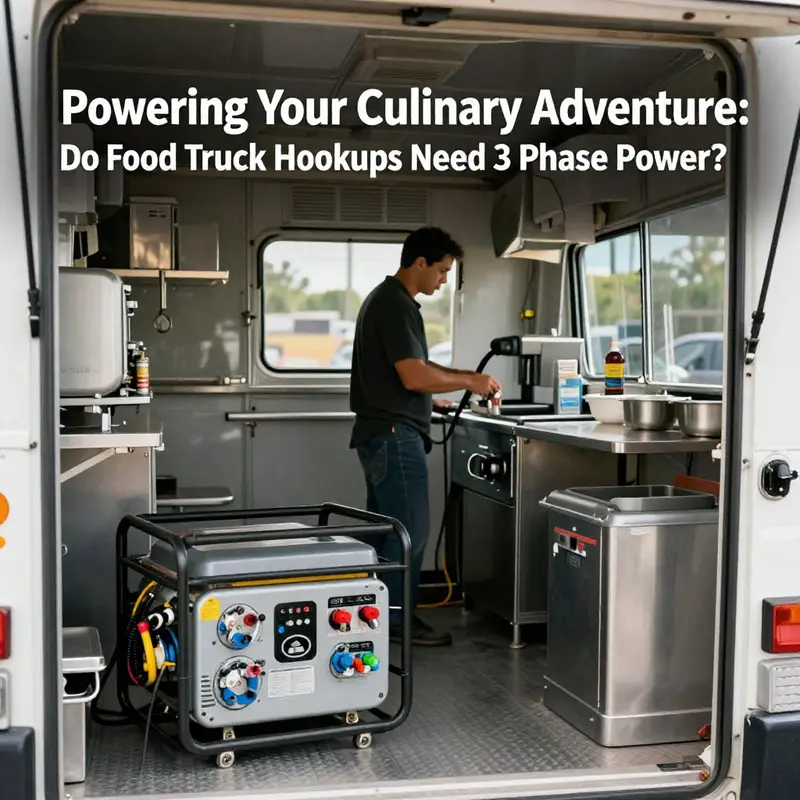
When a chef takes the stage on wheels, the invisible orchestra that makes a menu sing is the electrical system humming beneath the counter. For many operators, the question that sits at the center of every station setup is deceptively simple: do food truck hookups require 3-phase power, or can a robust single-phase supply carry the kitchen through lunch rushes, late-night events, and everything in between? The short answer is usually no. The longer answer, which this chapter explores with care, is that most food trucks run on standard single-phase power, and they do so reliably by designing around real-world loads, sensible buffers, and smart equipment choices. The myth that a three-phase connection is a hard prerequisite often stems from overestimating the power needs of heavy-duty equipment or from assumptions about industrial-grade kitchens. In practice, the event landscape—streets, fairs, pop-up markets, and curbside gigs—offers ample single-phase outlets, generator options, and portable power systems that, when sized correctly, exceed the demands of a fully functional mobile kitchen. The balance lies in understanding the loads, recognizing surge requirements, and selecting a power strategy that aligns with the menu and the workflow rather than with a generic industrial standard.
To begin with, the heart of a food truck’s electrical load is not merely the stove but the way the kitchen orchestrates its operation. A commercial griddle, for instance, usually sits in the range of 3,500 to 5,000 watts. A deep fryer can pull between 4,000 and 6,000 watts. Those figures alone would not overwhelm a modern single-phase service, but they do demand careful load planning, because both devices may not operate at full power simultaneously and because they draw surge power at startup. Add a refrigerator that runs around 800 watts but can spike to 1,800 watts when the compressor kicks in, plus a microwave around 1,200 watts, and kitchen tools like blenders or mixers that range from about 500 to 1,000 watts, and the total continuous demand can rise quickly. Lighting and a POS system, typically drawing an additional 300 to 500 watts, add more glide to the tangle. Taken together, these elements illustrate why an operator cannot rely on a single high-wart device-print estimate and must instead perform a careful, scenario-based load calculation that accounts for both running and startup currents.
The decisive factor is how these loads behave in real life. Not all appliances peak at the same moment, but a busy service often requires several high-watt devices to run in concert. A single 8,000—10,000 watt generator, or a robust single-phase utility hookup, generally provides a comfortable buffer for such simultaneous operation. Some operators pair a generator in the 6,000–8,000 watt range with a single-phase external feed when available; others lean on a larger portable generator to accommodate peak periods. The guiding principle is simple: you want enough headroom to handle the griddle and fryer warming up, the fridge cycling on and off, and the lights, POS, and prep tools all drawing without tripping breakers or sagging voltage. When the plan anticipates that multiple heavy devices may run at the same time, a larger generator becomes a safety net rather than a luxury. In the field, that buffer translates into smooth service, fewer shutdowns, and less stress during weekend surges. It also keeps the system from overloading a single circuit, which can lead to nuisance outages, melted fuses, or equipment damage.
What often tips the scales toward single-phase solutions is the practical availability of power at events. Vendors, parks, and pop-up sites typically provide single-phase connections, and many events are designed around a predictable electrical ecosystem that supports standard outlets and portable power distribution. For many operators, the choice between investing in a larger three-phase infrastructure and deploying a powerful single-phase generator or a combination of outlets comes down to a cost-benefit calculation and the flex needed for portable or temporary sites. Three-phase power offers undeniable advantages in some stationary kitchens or custom-built trailer setups with extensive, hard-wired machinery and multiple stoves that run on dedicated circuits. Yet the majority of mobile operations operate with a combination of single-phase utility feeds, generator power, and intelligently managed loads that keep the kitchen operating at peak efficiency without the complexity or cost of three-phase service.
To translate these ideas into concrete practice, operators frequently start with a careful audit of their equipment and their typical service patterns. List every appliance, its voltage, its continuous running wattage, and its startup surge. Then map these appliances against a few service scenarios: a single station with one high-demand appliance active, a two-station rush where both a griddle and a fryer are humming, and a prep phase where refrigeration and lighting dominate at a lower but steady rate. In most configurations, a total demand that falls under the 8,000–10,000 watt window remains comfortably within the reach of robust single-phase solutions. It is worth noting that even for kitchens that seem nerve-wrackingly intense—stoves, steam tables, and multiple heavy appliances—the right distribution and sequencing can keep a single-phase setup well within limits. Startups with refrigerators that cycle on and off, warming trays that only briefly spike, and a fryer that runs in steady bursts often find that the actual sustained load sits well below the peak ratings of individual appliances.
The practical takeaway is not that three-phase is never useful, but that it isn’t a universal necessity for food trucks. When three-phase power is encountered in a city or at a large fair, it is usually because the event has a fixed, permanent electrical backbone designed for long durations and higher power reliability. In such environments, operators might deploy a combination of single-phase feeds and power distribution with appropriately rated breakers. In others, a generator in the 6,000–8,000 watt range will cover most of the real-world needs, with the option to scale up to 10,000 watts for peak days. A reliable, well-matched generator becomes an extension of the kitchen — an ally that can be wheeled into a lot, connected to the truck, and kept fed through the service period. The moment a truck learns to respect startup surges, the days of tripped breakers and underpowered stoves become a memory.
A common area where some operators misjudge the situation is in assuming that all startup surges must be spared by a single, always-on powerhouse. In truth, startup power is a temporary demand spike. It can be managed by staging equipment use—turning on or preheating one device while another is still warming up, then bringing in the rest as the first load stabilizes. It can also be managed by having a properly sized generator that can deliver peak surge without wobble. This approach keeps the kitchen in a comfortable range, prevents voltage drop that could degrade performance, and minimizes the risk of nuisance outages that strain both staff and customers. The goal is not to eliminate surges entirely but to ensure they are brief and controllable within the system’s design envelope. When operators understand the difference between continuous load and startup surge, they gain a practical language for sizing equipment and selecting power sources that align with actual needs rather than perceived needs.
The province of this understanding extends beyond the kitchen walls. A truck’s electrical plan must align with planning permissions, safety standards, and generator maintenance realities. Generators, while portable and flexible, require proper ventilation, fuel management, and routine checks to ensure dependable operation during an event, especially in warm climates or extended service periods. Equally important is the distribution of power inside the truck. A well-designed distribution panel, properly rated breakers, and correct wiring practices protect equipment and personnel. The difference between a well-powered kitchen and one that noses into brownouts often rests on the quality of the power distribution, not merely the raw wattage available. In short, you don’t need three-phase power to create a kitchen that cooks well; you need a thoughtful, targeted approach to single-phase power that anticipates both running and surge demands, coupled with a distribution strategy that keeps every outlet and every circuit within safe, reliable limits.
For those new to the trade, the learning curve is less about chasing a universal standard and more about building a flexible, scalable system. A practical rule of thumb is to size your power plan to the heaviest single-day load you expect, plus a substantial buffer to cover startups and a few simultaneous devices. If that plan lands in the 8,000–10,000 watt territory, you are in the sweet spot where a single-phase approach becomes both feasible and durable. It’s a zone where you can run a robust grill, a fryer, a fridge, and essential ancillary equipment with enough headroom to spare during busy periods. It also leaves room for future growth—perhaps a second griddle, a larger fridge, or a more demanding freezer—without requiring an overhaul of the electrical backbone.
To connect these ideas back to what operators experience on the ground, think of power as a partner in service quality. A well-powered truck can turn orders faster, keep ingredients at the right temperatures, and maintain a stable service tempo even as the crowd grows. The time saved by avoiding power interruptions translates into smoother workflows, less staff fatigue, and, ultimately, better customer satisfaction. In practice, this means careful planning from the moment a menu is designed and a layout drawn. It means choosing equipment that balances performance with efficiency, selecting a generator or power source that provides reliable support, and implementing a load management strategy that staggers peak demands instead of letting them collide. When these elements are aligned, the question of three-phase power recedes into the background, not because it is irrelevant but because it is rarely necessary for the typical mobile kitchen.
If you’re weighing your truck’s electrical footprint, consult Choosing the right food-truck model which explores the power implications of different configurations. This resource helps illuminate how equipment choices, layout, and expected service patterns interact to shape the electrical plan, reinforcing the idea that a single-phase strategy, when executed with care, can reliably support a modern, high-performing mobile kitchen.
Beyond the math, the practice of powering a food truck is also a discipline of listening to the equipment’s rhythms. Refrigeration cycles on and off with the door openings of a busy service, the fryer and griddle may demand bursts of energy that diverge in timing, and lighting, fans, and ventilation demand a constant, predictable baseline. The art lies in orchestrating those rhythms so they propel the service forward rather than collide with one another. A well-tuned system understands that big loads don’t always have to run at the same time and that the most important moment—service time—gets priority access to the available power. The kitchen can then operate with confidence, knowing that the electrical backbone is sized to tolerate the typical procession of events, from prep through peak service to closing duties.
Of course, every operation is unique. A truck serving a heavy menu—think large flat-top cooking and multiple fryers—may push the envelope and appear to demand more than a typical single-phase system. In those cases, the safer route is a generator with a robust surge capacity or a back-up plan that includes a second feed for critical circuits. The goal remains intact: avoid the kinds of power gaps that stall cooking lines, slow down service, or compromise food safety. The path to this reliability is precise load calculations, prudent equipment selection, and a willingness to adapt the electrical plan to the realities of the site rather than to the aspirational ideal of a fixed three-phase grid.
As the industry evolves, so too will the tools and strategies available to operators. There are ample case studies, guides, and field-tested configurations that demonstrate how large, vibrant mobile kitchens achieve high performance with single-phase power alone. The practical truth is that three-phase power is not a default requirement for the majority of food trucks. What matters is a deliberate, data-informed approach to power—one that recognizes the true demands of the menu, anticipates startup surges, and employs a generator or utility connection that provides a healthy margin for growth and peak demand. In this light, the electrical heart of a food truck becomes less about chasing a standard and more about delivering consistent, high-quality service through responsible planning, disciplined load management, and the creative use of portable power where needed. The result is a kitchen that can cook, fry, chill, and illuminate without being tethered to an assumption that three-phase power is the only route to reliability.
External Resource: For a deeper dive into sizing strategies, troubleshooting, and best practices for powering a food truck with generators and single-phase power, see a detailed external guide at https://www.powermatters.com/food-truck-generator-power-needs.
null
null
Wired for Service on the Move: Debunking the 3-Phase Myth in Food Truck Hookups
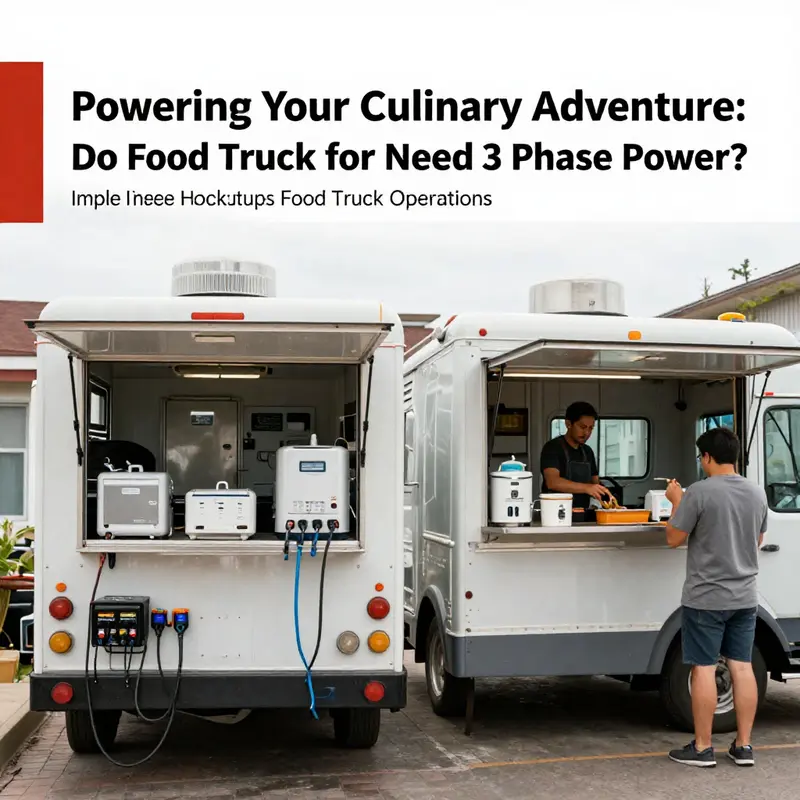
Power is not merely a technical detail for a food truck; it is the quiet engine behind every service window, the unseen conductor that keeps the line moving and the orders consistent. In conversations about mobile kitchens, a common debate centers on whether food truck hookups require three-phase power. The quick, practical truth is simpler than the billing sheets would suggest: for the vast majority of modern street kitchens, single-phase power is more than enough. Yet the conversation matters, because the choice between single-phase and three-phase power shapes everything from equipment selection to expansion plans and even the venues you can work. In the end, the decision comes down to how you design your load, how you plan for peak demand, and how you balance reliability with cost. When you glimpse the math behind the everyday kitchen, it becomes clear that three-phase power is not a universal requirement; it is a specialized tool for a relatively narrow set of operations.
To understand why single-phase power so often suffices, consider a typical menu and the equipment that a modest mobile kitchen tends to rely on. A commercial griddle sits at the heart of many operations, drawing roughly 3,500 to 5,000 watts. A fry station can pull 4,000 to 6,000 watts, depending on the pan size and burner design. A compact refrigerator lives in the 800-watt running range, with surge potential up to about 1,800 watts when the compressor kicks in after a door swings open or a night of heavy use ends. Add a microwave, a blender or two, a POS terminal, compact lighting, and perhaps a small oven or induction surface, and the cumulative demand begins to look like a carefully managed stack rather than an endless electrical river. The numbers matter not only for the equipment you own but for the kind of venue you rely on. Event organizers often provide a standard single-phase hookup, and many parking lots, shared kitchens, and pop-up zones are wired with single-phase service that is more than sufficient for a well-planned operation.
In practice, the backbone of most mobile kitchens is a robust single-phase system. This is not merely a convenience; it is a practical design choice. A single-phase setup emphasizes simplicity, straightforward electrical code compliance, and broad compatibility with the venues you’re likely to encounter. A well-chosen, single-phase generator in the six- to eight-thousand-watt range can accommodate the high-load appliances when you need to run several power-hungry devices at once. The appeal lies in predictability: one circuit type, one set of plug configurations, one set of safety considerations, and a generator that can be trailered or parked alongside the kitchen with relative ease. For many operators, this translates into faster setup, easier maintenance, and less dependence on specialized electrical infrastructure at every venue you visit.
Yet power is a spectrum, not a binary choice. Three-phase power, typically delivered at 208V or 240V in mobile contexts, offers meaningful advantages when you push your equipment list beyond the basics. It clears a path for more balanced load distribution, reducing voltage drops and curbing the risk of tripping circuits when multiple high-draw devices operate simultaneously. The mathematics behind three-phase power is straightforward: by distributing the electrical load across three separate conductors, you can achieve higher total output without overloading any single phase. In theory, that means you can run more devices, or bigger devices, at the same time, without sacrificing performance. In practice, however, this advantage comes with complexity and cost that do not always align with the realities of a mobile kitchen.
The challenge with three-phase in a street-food or pop-up context is not only the initial installation but ongoing maintenance and compatibility. Three-phase systems require more sophisticated generators, transformers, and transfer equipment. They demand careful phase balancing, which becomes a juggling act when your menu evolves or you switch venues week to week. The generator fleet that supports three-phase operation tends to be larger and less portable than its single-phase counterparts. It also calls for wiring configurations and outlet types that may be unfamiliar to venues that are accustomed to standard 120V single-phase hookups. All of this translates into higher upfront costs, more intricate safety checks, and a longer path to return on investment. Operators who prize rapid deployment, consistent uptime, and simple service plans often find that the single-phase route aligns more closely with their business model.
But the decision is never just about equipment counts. It also hinges on how you plan to scale. For a truck that plans to grow into a kitchen with multiple high-draw appliances—an extended range, larger steam equipment, or heavy-duty refrigeration—three-phase might appear to offer a clearer ceiling. The reality, however, is that many growth trajectories can reach the same end through smarter load management and strategic sourcing of power. Upgrading a single-phase system to higher watts, or pairing a single-phase generator with energy management devices that optimize when high-draw appliances operate, can deliver a surprising amount of headroom without the expense and complexity of a three-phase installation. In the world of mobile catering, where venues and schedules are variable, the adaptability of a well-managed single-phase setup often outperforms a fixed three-phase configuration that ties you to a particular type of venue or electrical contractor.
The practical implications extend beyond the hardware. In selecting a power strategy, operators must consider the interface between the truck and the venue. The majority of events and parks provide standard 120V outlets, with occasional 208V or 240V access at select locations. This means you need to be prepared to pull power in ways that align with those options. A single-phase system is typically designed around 120V distribution, with a plan for 240V where available. You might use a generator that provides a clean 120/240V split or 120V circuits with a dedicated 240V feed for specific high-demand devices. The key is not to chase power infrastructure you are unlikely to encounter, but to design a robust, modular approach that matches the typical venues in your rotation. That approach keeps you nimble in the field and minimizes the risk of surprises when the oven trips or the fridge kicks in a surge during a busy service.
This is where a disciplined load calculation becomes your best ally. Start with the largest consumers: griddles and fryers. Add the refrigeration and any standbys that stay on during service. Consider the surge power requirements; a compressor starting up can briefly demand more than the running load. Then layer in auxiliary equipment like microwaves, blenders, and lighting. A seasoned operator will not simply add up watts; they will map the timing of usage. Some devices run flat out only during lunch rush; others stay on throughout the event to preserve product integrity. By sequencing operation, using soft-start devices where possible, and deploying energy-efficient models, you can keep total demand within the capabilities of a single-phase system without sacrificing performance.
There are unmistakable signs that three-phase power is beneficial, and you will know them when you encounter them. If you consistently operate a kitchen with multiple heavy-duty appliances, or you are planning to host large cooklines that include several high-heat devices and steam equipment at the same time, three-phase power becomes a more reasonable strategic consideration. It offers a smoother distribution of load and better efficiency for continuous, high-demand operations. In such scenarios, the decision is less about denying capabilities and more about aligning your electrical platform with your menu vision and venue network. Even then, many operators find that a carefully engineered single-phase setup, augmented by a capable generator and smart energy management, can deliver the same performance without the added complexity of three-phase wiring and the associated service agreements.
As you weigh these options, you’ll also hear industry voices that emphasize the benefits of three-phase for larger operations. A recent perspective from a generator-focused guide notes that three-phase power offers advantages for larger operations with multiple high-draw appliances but requires more sophisticated generator systems. That statement is not a ruling against single-phase; rather, it underlines a truth you can apply on the road: power strategy should be driven by current needs and future plans, not by a theoretical maximum. If your business plan envisions expanding to a kitchen that hosts several heavy appliances daily, a three-phase setup might be a sensible investment. If your plan centers on mobility, flexibility, and repeatable results across a wide array of venues, the single-phase route remains the most practical path forward.
For operators who want to connect theory to practice, the approach is simple. Map your average service, then build a contingency for peak demand. Invest in a robust single-phase generator with a generous wattage cushion, and pair it with an energy-management strategy that prioritizes essential devices during service and phases in nonessential loads as power allows. This mindset yields reliable uptime, predictable performance, and the kind of operational resilience that can make the difference between a good night and a great night on the curb. When you pair your generator choice with an intuitive load sequence and a menu designed around plug-and-play efficiency, you are embracing a pragmatic future: one in which the truck, the crew, and the venue all arrive ready to perform, with power playing a steady, unremarkable role in your success.
The practical takeaway for most operators is clear. Do you need three-phase power for your food truck hookup? Not typically. For the majority of fleets, single-phase power—supplemented by a well-chosen, capable generator and deliberate load management—delivers the reliability, scalability, and cost efficiency that mobile kitchens depend on. Three-phase power remains a valuable option for a subset of high-capacity, high-output operations, particularly those with very large cooking lines or a constant demand for simultaneous heavy loads. But even in those cases, a thoughtful design can achieve near-parity with three-phase performance through smart equipment choices, staged power use, and a scalable single-phase infrastructure that travels well from one gig to the next. The bottom line is practical and straightforward: know your menu, know your venues, and design your electrical system to meet real-world needs rather than theoretical potential. In that sense, the road to reliable power for your food truck runs on clarity of purpose, not on the promise of three-phase power.
If you’re curious about how other operators approach this question and want a broader framework for choosing the right model for your business, consider exploring guidance focused on planning and model selection. For instance, a detailed discussion on choosing the right food truck model can provide a useful context for how you balance vehicle, kitchen equipment, and power strategy in a single, cohesive decision. Choosing the Right Food Truck Model offers practical perspectives that can align your electrical planning with your overall business plan, helping you see how power choices fit into the bigger picture of operations, reliability, and growth.
For those who want to explore external resources that dive deep into generator systems and power reliability for mobile kitchens, a respected guide provides a thorough overview of the equipment mix and backup considerations. The guide emphasizes how robust generator systems can support a wide range of kitchen configurations, including the implications for single-phase versus three-phase setups. External resource: https://www.ecoflow.com/blog/food-truck-power-essential-generator-systems-guide. This resource background can help you evaluate whether your current setup has the headroom to handle future growth or if a staged upgrade is warranted as your menu expands and your service volume increases.
Beyond Three-Phase Power: Designing Reliable Single-Phase Systems for Mobile Kitchens
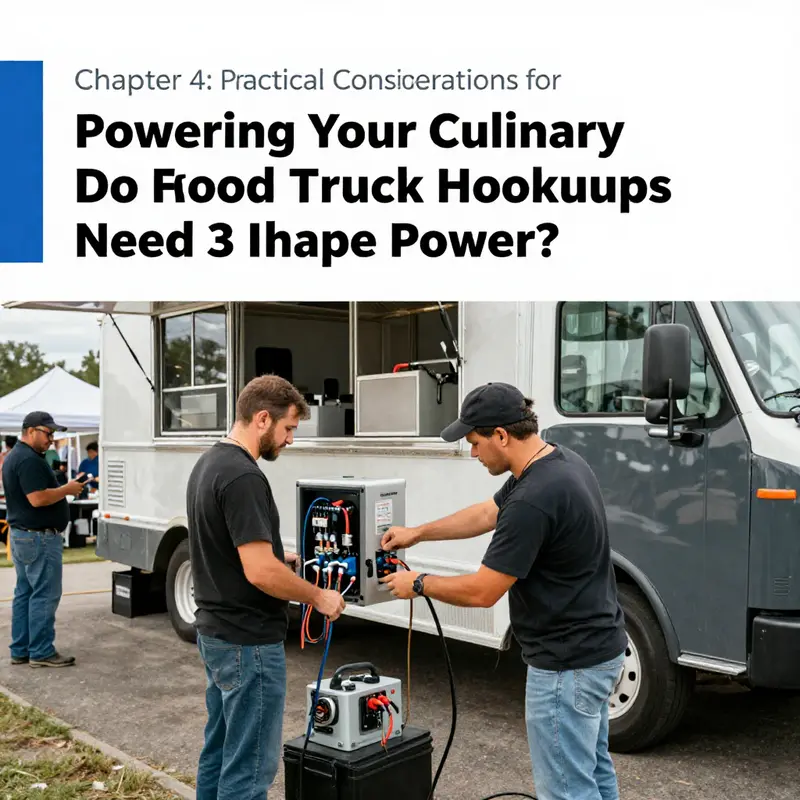
Do food truck hookups truly require three-phase power? In everyday operations, the answer is typically no. Across city streets, festival grounds, and the parking lots where pop-up kitchens bloom, single-phase power provides the energy a mobile kitchen needs, with margin for contingencies when paired with thoughtful planning. Three-phase power remains a staple in fixed commercial facilities and some larger catering venues, but for a truck that must roll between sites, the practical path is a robust single-phase setup supported by portable generation and disciplined energy use. The difference isn’t a matter of abstract engineering; it’s a question of how equipment is deployed, how power is delivered at the curb, and how reliably the system can respond to the unpredictable rhythms of a busy service window. In other words, three-phase power is not the default expectation for most food trucks, and it rarely becomes a barrier when a truck is equipped with a well-conceived single-phase strategy that matches real-world use.
The practical picture comes into focus when you tally the actual loads a mobile kitchen must support. A typical truck’s electrical demand breaks down into four broad categories: cooking equipment, cold storage, small appliances and electronics, and lighting. A commercial griddle commonly runs in the 3,500–5,000-watt range, depending on plate size and how aggressively it is used. A fryer another 4,000–6,000 watts, with startup surges often higher than running levels. A refrigerator consumes about 800 watts in steady operation, with surges up to roughly 1,800 watts when compressors start after a power interruption or when doors are opened for a flurry of stock transfer. Add microwaves, blenders, POS systems, and a raft of LED lighting, and the running load can accumulate quickly. The essential insight from field experience is not simply the theoretical sum of device wattages, but how and when those devices demand energy during a service shift. A kitchen that staggers start-up sequences and cycles appliances can operate well within the capacity of a solid single-phase supply. This is the backbone of practical mobile power: engineers design for real-world usage patterns, not for the most energy-hungry moment that could occur in a lab setting.
This brings into focus the role of power sources. Many trucks rely on portable generators paired with utility hookups at events. A generator in the 6,000–8,000-watt range can cover heavy-duty stoves and steam tables when used with prudent load management. The key is to balance capability with control. Start the most energy-intensive device first only when its surge can be absorbed by the system without tripping breakers or sagging the voltage for the rest of the crew. Then allow other equipment to come online in a controlled sequence while refrigeration keeps its rhythm. In practice, the total peak demand a truck can tolerate on a single-phase system is a function of how loads are scheduled, not a fixed ceiling dictated by the electrical phase alone. This perspective helps explain why many operators achieve reliable performance with a robust single-phase arrangement rather than chasing a three-phase upgrade.
There are, of course, exceptions. A few high-volume, multi-station trucks with numerous electric stoves, steam tables, and perhaps a built-in dishwasher approach may push the envelope of what a mobile single-phase supply can comfortably support. In such cases, a larger generator or a dedicated, site-supplied service can be coordinated to deliver higher instantaneous power. Even then, the end result often remains a single-phase configuration because the distribution plan inside the truck revolves around careful circuiting—each major appliance fed from its own dedicated circuit and designed to minimize shared loads that can cause nuisance trips. The practical conclusion is that three-phase power becomes an optimal solution only when the scale of the operation and the site’s electrical infrastructure align in ways that exceed the capabilities of well-planned single-phase installations.
The safety and compliance dimension anchors any discussion about electrical installations. The guidepost is adherence to national and local electrical codes, with the National Electrical Code (NEC) serving as a cornerstone in many jurisdictions. The emphasis is not merely about meeting minimums; it’s about building a system that can tolerate motion, temperature swings, and the vibrations inherent to transit. Durability matters as much as capacity. Cables must be properly rated and protected, connections secured against movement, and circuits protected by appropriate breakers. Because a food truck operates in moisture, heat, and grease, the installation must be robust against heat sources that can degrade insulation or degrade contact integrity over time. A disciplined approach to grounding and bonding, along with proper isolation of high-draw circuits, reduces the risk of shock hazards and equipment faults that could stop service on a busy night. The practical implication is clear: a safe, compliant, single-phase system is not a compromise but a foundation for reliable mobile service when designed with care.
Cable management is the practical art that makes the theory work under pressure. In a mobile kitchen, power leads are more than cables; they are the lifelines that keep refrigerators cool, lines hot, and POS systems online. Keeping leads away from heat sources such as fryers, grills, or sinks is essential, but so is securing them so they cannot be damaged by wind, vibration, or foot traffic. Tripping hazards are not just a nuisance; they can create dangerous situations around hot equipment. A well-organized layout uses clips, conduits, and clearly run pathways to prevent abrasion and accidental disconnection. The effect is not only safety but efficiency. A neatly routed electrical system reduces setup time, minimizes the chance of damage, and communicates professionalism to event organizers and customers alike. In addition, weather protection—weatherproof outlets and rugged enclosures—ensures that a pop-up kitchen can endure rain, humidity, or seasonal temperature swings without compromising power integrity.
Backup power is more than a convenience; it is a business resilience strategy. In markets where grid reliability is uncertain or in outdoor venues susceptible to outages, planners build redundancy into the electrical architecture. A backup strategy might include a generator capable of covering critical loads during a brief outage, or a battery-based system designed to maintain refrigeration and essential lighting while the main supply is restored. Importantly, sizing for peak simultaneous demand is crucial, not just average load. A well-conceived backup plan reduces the risk of food spoilage, maintains customer service standards, and lends confidence to event organizers who rely on dependable operation. It also offers a practical hedge against the unpredictable rhythms of outdoor service, where weather and crowd dynamics can push power needs up or down in an instant. The aim is a resilient operation that can keep showing up with hot food and cold stock, even when the power source hiccups.
The broader context of practice in the electric-food-truck world emphasizes that power strategy is as much about process as it is about hardware. A mobile kitchen must perform across a spectrum of environments—from busy city streets to remote fairs—so the electrical system has to be versatile. Outdoor use, in particular, demands weatherproof enclosures, safe outdoor-rated outlets, and protective devices that can withstand exposure to the elements. Staff training matters as much as the gear. Operators should understand the energy flow, the risk of initiating multiple high-draw appliances at once, and the importance of sequencing to avoid dimensional dips in power. Even the most careful planning can falter if staff overlook basic safety practices, so ongoing training and clear operating procedures are essential. Periodic maintenance by a licensed electrician helps keep the system trustworthy: connections stay tight, insulation remains intact, and safety devices function as designed. Documentation of inspections creates an audit trail that supports regulatory compliance and can be vital in the event of an incident.
To connect theory to practice, many operators approach power with a philosophy of disciplined planning and ongoing optimization. They produce a load profile for a typical service window, identify the maximum sustained demand, and map it against available single-phase capacity. Then they devise contingency strategies—load shedding, staggered operation of heavy appliances, and ready access to backup power—that keep service smooth without compromising safety. This mindset aligns with broader industry discussions about electrical standards and best practices. Those seeking a more formal exposition of the regulatory landscape and practical implementation guidelines can refer to resources that discuss navigating food truck industry regulations, which provide context for how different sites evaluate electrical readiness and compliance. navigating food truck industry regulations
The literature on electric food trucks reinforces a central, pragmatic truth: three-phase power is not a universal prerequisite for most mobile kitchens. It is a solution to a particular class of high-capacity, fixed-site constraints, not a default for every street operation. The win for most operators lies in a well-proportioned single-phase system that can deliver steady performance at the curb, paired with sensible backup options and a disciplined approach to load management. Properly sized generators, combined with robust cable management and routine maintenance, can provide the reliability customers expect while keeping capital and operating costs in check. And when sites demand more than a single-phase can comfortably supply, the answer is not to force three-phase into a mobile setting but to align the system with the realities of the site—to secure stronger single-phase support or to coordinate with the host facility for higher-capacity service. For those who want a deeper dive into the evolving landscape of standards and practical recommendations for electric food trucks, Grace Holden’s recent exploration of composition, standards, and best practices offers a comprehensive synthesis of the field. External reference: https://www.linkedin.com/pulse/exploring-small-electric-food-truck-composition-standards-best-practices-grace-holden-january-2026/
Final thoughts
As we conclude our exploration into whether food truck hookups need 3-phase power, it’s clear that most food trucks are more than capable of running off a single-phase system. Understanding the power requirements not only aids event planners and organizers in making informed decisions but also ensures that food enthusiasts can enjoy their culinary experience without a hitch. Powering a food truck need not be complicated, and with the right information and resources, connecting these bustling kitchens to reliable power sources is straightforward. Keep these insights in mind as you plan your next event, and ensure that your culinary endeavors are always well-fed and powered up!