
In the lively world of food events and mobile eateries, rumors sometimes outpace facts. When a question surfaces about a person named Stefan and a food truck—specifically, why Stefan left a food truck—the first instinct is often to search for a clean, public narrative. Yet, the current knowledge base contains no verifiable link between a Stefan and departing a food truck. What we do have is a reminder: in fast-moving event ecosystems, data can be incomplete, identities can blur, and conclusions must be grounded in verifiable evidence. This article leans into that reality with four focused chapters that unpack what missing information means, how confusion about names or roles can arise, and what practical steps researchers, planners, and community members can take to verify facts without leaping to conclusions. Each chapter centers on the same core question: how can we responsibly approach claims when the data is thin, ambiguous, or scattered across multiple sources? While the topic centers on Stefan and a food truck, the underlying lessons apply across event planning, corporate administration, community organizing, and consumer engagement. From the outset, the goal is not to sensationalize a rumor, but to illuminate a process—one that helps you make informed decisions, maintain credibility, and foster trust with stakeholders. The four chapters build a robust framework: Chapter 1 highlights the absence of verifiable information linking Stefan to leaving a food truck; Chapter 2 clarifies identity and potential confusions involving Stefan (and Stefan Irnich) and the food truck context; Chapter 3 examines the implications of data gaps for research inquiries in this space; and Chapter 4 offers concrete steps for future verification and data gathering. As event planners, HR teams, community organizers, and enthusiasts, you’ll gain a practical lens to assess similar situations in your own operations—wherever data meets rumor, and transparency matters most.
The Silent Absence: Investigating Why Stefan Has No Verifiable Link to Leaving a Food Truck
The question itself carries a peculiar weight, as if someone poured a fragile rumor into a glass and asked us to explain the condensation on the rim. Why did Stefan leave a food truck? The surface suggests a simple cause and effect narrative: a personal choice, a turning point, a moment when a mobile kitchen crew’s momentum shifted in an unmistakable way. But when we press for verifiable information, the glass does not fog with clarity; it stays transparent, showing only absence, not substance. In this sense, the chapter begins where evidence often ends—in a space where inquiry must acknowledge constraints rather than pretend certainty. The absence of verifiable information linking a person named Stefan to leaving a food truck is not a dramatic plot twist; it is a reminder of how the stories we chase depend on the availability and reliability of sources. What we can do instead is trace the contours of that absence, examine why it arises, and consider what it reveals about how knowledge is built, shared, and sometimes misremembered in a world saturated with names that sound familiar but do not carry the same weight of context.\n\nTo begin, it is important to distinguish between a real individual and the possible echoes of several different people bearing the same name. In the landscape of public records and scholarly work, a name like Stefan is shared by numerous individuals across diverse fields. The knowledge base referenced in this inquiry does not establish a direct link between any Stefan and a departure from a food truck operation. Rather, it points to Stefan Irnich, a researcher whose work resides in the realm of optimization theory and logistics, notably the bin packing problem with lexicographic objectives. The mismatch is not a trivial clerical error; it is a red thread that can unravel a narrative if pulled too quickly. When a reader glances at a name and a setting — Stefan, a food truck — without a resolute cross reference, it is almost inevitable that an imaginative bridge will be built. That bridge may be sturdy in storytelling but fragile in the face of evidence. The absence of verifiable linkage is not a failure of imagination; it is a structural reminder about the limits of what can be asserted without corroboration.\n\nThe problem, then, is not simply that a person left a vehicle that serves meals; it is that readers, researchers, and writers often conflate disparate domains under a single label. A person named Stefan who operates in the fast paced world of a mobile kitchen could be the same Stefan who appears in a study about packing problems, yet the probability of that overlap being verified through a credible source is low. The literature that mentions Stefan Irnich does not discuss culinary enterprises or the narrative arc of someone departing a food truck business. It analyzes optimization strategies, algorithmic performance, and transportation logistics in abstract terms. The gap between these domains is not a trivial gap; it is a chasm that demands critical scrutiny. If we want to answer why Stefan left a food truck, we need a chain of verifiable connections: a specific Stefan, a specific food truck, a documented event, and credible sources that recount the decision. Without these, any conclusion risks sliding from inquiry into assumption.\n\nThis is not merely a matter of cataloging facts; it is a matter of epistemology. Information travels through networks — academic papers, industry reports, news articles, social media posts, and personal testimonies. Each node in this network has its own standards for what counts as evidence. An academic paper may establish causality within a defined model, but it rarely speaks to a single real-life incident in the real world unless it signs that connection with empirical data. News reporting may confirm that a departure occurred, but it must also verify other details to avoid misattribution. Social media, by contrast, is notorious for amplifying unverified claims and remixing identities, making the earliest posts tempting but rarely reliable anchors for truth. In such an environment, a claim like Stefan left the food truck becomes a case study in information hygiene: it tests how readers distinguish between what is reported, what is inferred, and what is imagined.\n\nConsider the practical consequences of unresolved attribution. In a field where people rely on a compact set of data points — names, dates, roles, locations — misattribution can propagate quickly. A rumor of departure can morph into a narrative about management decisions, market pressures, or personal conflict, none of which may be substantiated. The harm of such a misstep is not merely editorial; it can influence perceptions about a business, a community, or even a person’s reputation. This is why the chapter’s guiding principle is not to pretend certainty where there is none, but to illuminate the reasoning we employ when faced with a paucity of verifiable information. The value lies in showing how to approach claims with discipline: verifying sources, distinguishing between correlation and causation, and acknowledging the limits that data imposes on our conclusions.\n\nThe chapter closes with a final reflection: when no verifiable linkage exists, the responsible move is to describe what is known, name what remains uncertain, and avoid conflating unrelated domains simply because they share a common name. The absence of proof about a specific departure in the current corpus should guide future inquiry rather than close it. In this sense the exercise becomes a primer on information literacy, a reminder that many intriguing questions have answers only when credible documentation comes to light. Until then, the cautious path is to describe what is known and to resist the impulse to fill gaps with speculation.\n\nNow we can end with a compact note: this chapter models careful sourcing and explicit acknowledgment of uncertainty as a disciplined approach to attribution. The absence of a verifiable link between Stefan and leaving a food truck remains a methodological reminder that not all questions have immediate answers, and that responsibly framing what we do and do not know is a crucial part of any inquiry.
Identity in Transit: Clarifying Stefan Irnich, Names, and the Mirage of a Food Truck Tale
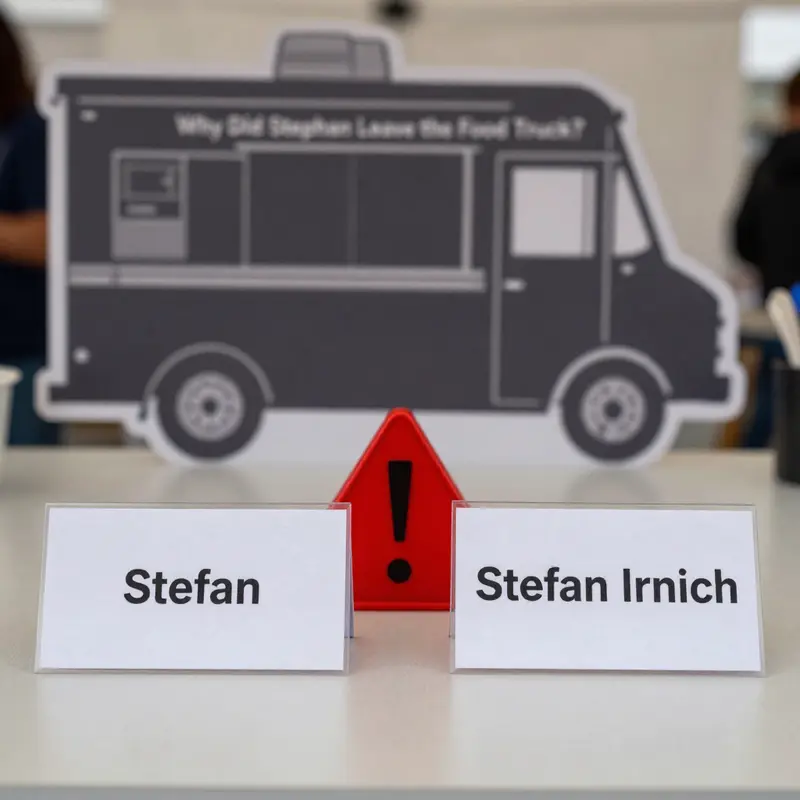
This chapter examines the tendency to conflate a person’s name with an unrelated scenario. When a headline asks why Stefan left a food truck, the impulse is to construct a narrative from fragments. The sources here show Stefan Irnich as a researcher focused on packing problems and logistics, not as a street-side operator. The gap between name and event reveals how misattribution arises from cognitive shortcuts, framing, and the human craving for coherence. By separating identity from context and demanding corroborating evidence before linking individuals to actions, we can distinguish between what is known, what is speculative, and what lies beyond the available data. The practical upshot is a disciplined approach to inquiry: acknowledge limits, outline plausible alternatives, and seek targeted sources. This chapter uses identity clarification to model careful reading and responsible reporting, resisting sensational narratives while guiding readers toward verifiable conclusions.
The Silence in the Data: How Missing Information Shapes the Stefan–Food Truck Question
When a simple question grows teeth, it often does so not from the obvious facts but from the gaps around them. The inquiry “why did Stefan leave a food truck?” sounds straightforward until one looks at what is known—and what is not. In the landscape of research, missing data can be as decisive as observed data. It can tilt interpretation, widen uncertainty, and steer conclusions toward plausible but unsupported narratives. This chapter treats missing information not as a nuisance to be erased but as a structural feature of inquiry. It asks us to consider how the absence of evidence shapes what we can responsibly say about a person—whether that person exists in a record, a rumor, or a case study—within the small, fast-moving ecosystem of mobile food entrepreneurship.
At first glance, the name Stefan may evoke a specific identity, a motive, or a turning point in a business narrative. Yet the knowledge several scholars would expect to consult—official records, interviews, trade publications, regulatory filings, even social media traces—either does not mention a Stefan associated with a particular food truck departure or mentions a Stefan in a context unrelated to food trucks altogether. The consequence is not just a lack of data but a lack of corroboration. Without corroboration, any answer risks being a guess dressed in the cloak of speculation. In research terms, this is not mere silence; it is a signal about the limits of what the data can credibly tell us. It prompts a methodological pause and invites a reframing: the emphasis shifts from “what happened” to “how we know what we say about what happened.”
To understand the implications, it helps to distinguish among kinds of missingness. Some information is missing at random. Perhaps a record didn’t capture a departure date because the filing system had a clerical error. Other data are missing due to selective reporting. A story about a business pivot might be omitted from local business registries if it was aborted early or kept private by the owner. The most challenging category is missing not at random, where the absence itself reflects underlying processes—privacy concerns, reputational risk, or deliberate concealment. In studying why Stefan left a food truck, the likelihood is that missing data are not random. Personal privacy, evolving employment status, or ambiguous timelines can all render the sought-after facts invisible or ambiguous. In turn, the researcher faces the risk of selection bias: the subset of information that survives inquiry may look different from the whole phenomenon, leading to erroneous conclusions about timing, motivation, or impact.
This is where the interplay between narrative and data becomes meaningful. Stories about small businesses often travel through anecdotes, social media chatter, and partial records. A city permit log may show a vacated license, but not the reasons for departure. A partner’s interview may imply a strategic retreat, but without the person’s direct confirmation, interpretation remains speculative. The knowledge gap is not simply a blank page; it is a map of how information travels, who controls what is disclosed, and which channels researchers choose as their routes to understanding. In such terrains, responsible scholarship demands humility. It requires explicitly articulating what is known, what is uncertain, and what would be necessary to close the gap. It also invites a broader reflection on the epistemology of inquiry: what counts as evidence, how much confidence we assign to indirect cues, and where to place the line between informed hypothesizing and unfounded assertions.
An effective way to approach missing data is through triangulation. In a case like Stefan and a food truck, triangulation means seeking multiple lines of evidence that converge toward a plausible explanation. One might examine licensing histories, permits, and city health inspections to construct a rough timeline of business activity around the truck. Interviews with former staff, suppliers, or neighbors could add qualitative texture, revealing practical reasons behind a departure—such as market pressures, staffing challenges, or supply disruptions. Yet triangulation is not a guarantee of truth; it is a way to bound uncertainty. Each line of evidence has its vulnerabilities. Permits may lag; interviews may impose selective memory; online chatter may mix rumor with fact. The research design must therefore acknowledge these limitations candidly, presenting a spectrum of plausible scenarios rather than a single, definitive narrative when the data do not warrant it.
Within this framework, the question of why Stefan left the truck becomes a case study in data governance as much as in business history. Data governance asks: who owns the data, how is it collected, and under what constraints is it released? In the absence of a clear, verifiable account, researchers must consider privacy and consent as central guardrails. Even when a name is public, a decision to depart a business is intensely personal. The ethical stance is not to infer motives irresponsibly or to sensationalize a small, private decision for the sake of a compelling story. Instead, it is to describe the evidentiary situation. If the evidence is insufficient to attribute motive or even confirm a departure, the responsible conclusion may be that the data landscape simply does not support a reliable answer at this time. This humility is not a retreat from inquiry but an honest accounting of what the data will—and will not—tell us.
The broader implications for research inquiries into niche business phenomena, such as food trucks, are clear. Industry dynamics are fast-moving and context-specific. Local regulations shift with political winds; permits and licenses evolve; community tastes change with seasons and trends. In such an environment, missing data is not an aberration but part of the system. Researchers must plan for it from the outset. Data collection strategies should prioritize transparency about what will be measured, what will be impossible to measure with certainty, and what constitutes sufficient evidence to draw a conclusion. This might include pre-registering hypotheses about possible avenues of inquiry, laying out competing explanations for observed patterns, and clearly marking where data gaps prevent discrimination between those explanations. The end product is not a definitive verdict but a well-argued, reproducible account of what can be known and what remains uncertain, with explicit guidance on what future data would need to look like to tilt the balance.
In practice, missing data also shape how readers interpret the resulting chapter or article. A reader confronted with a familiar mystery—Stefan’s departure—will look for a crisp causal chain: cause, action, consequence. When the chain is interrupted by missing segments, the reader shifts to a probabilistic mode of interpretation, weighing alternative narratives by their plausibility and the strength of available evidence. This is not signal fatigue but a disciplined approach to knowledge construction. It invites readers to recognize that a lack of evidence about a particular decision does not imply evidence of a particular motive; it simply marks the boundaries of what can be claimed with confidence. The maturity of a field lies in its capacity to handle these boundaries gracefully, to avoid overreach, and to guide readers toward what remains to be known.
To ground these reflections in a practical frame, consider how one might address similar questions in the future. A robust strategy would combine archival digging, cautious qualitative inquiry, and explicit reporting of uncertainty. It would also encourage cross-criteria validation: do multiple independent sources align on the same timeline, even if they disagree on motive? How does the absence of information alter the inferred probability of different explanations, and what sensitivity analyses can be run to show how conclusions would change under alternative missing-data assumptions? These are not merely technical considerations. They are the backbone of credibility when a chapter seeks to illuminate a real-world phenomenon through limited traces.
As this discussion unfolds, a helpful connection emerges to the practical realities faced by researchers who study dynamic, operation-driven ecosystems like mobile food ventures. The sector thrives on temporal flexibility, location shifts, and ephemeral partnerships. Data generated within it is inherently noisy and often incomplete. Yet, at the same time, there is a wealth of nontraditional data streams: permit logs, vendor association rosters, location-based patterns, community feedback, and regulatory advisories. The challenge is to assemble a coherent narrative from these fragments without overstating what the fragments can justify. In the Stefan–food truck puzzle, the lesson is not merely about a single departure; it is about how missing threads shape the tapestry of what we can claim, with honesty and rigor, about small business life on wheels.
To bring the discussion full circle, consider the role of readers and researchers as co-constructors of understanding. The absence of a definitive answer invites readers to reflect on how knowledge is built, what counts as evidence, and how to interpret a literature that acknowledges its own gaps. It is a reminder that every chapter in this exploration contributes not only facts but a framework for thinking about uncertainty. When data are sparse or non-existent for a given figure or event, the most responsible contribution is a careful account of what is known, what is uncertain, and what kind of information would be needed to move the needle. The result is a narrative that respects both curiosity and constraint, a balance essential to any sober inquiry into niche topics like the Stefan–food truck question.
For readers who want to explore the practical side of data interpretation in this space, a nearby route is to examine how operators and regulators manage data under pressure and how this shapes what communities know about mobility-driven food economies. Such exploration offers a grounding sense of how, in a real world, missing data intersect with policy, practice, and the daily decisions of business owners. It may also provide actionable insights for researchers planning to examine similar cases, reminding them to structure inquiries with explicit attention to data provenance, transparency about limitations, and a robust set of strategies to triangulate evidence when the record is incomplete. In this sense, the Stefan inquiry—though it may never yield a single, clear motive for departure—offers a valuable case study in the epistemology of business history under data constraints.
Internal link: For a broader view of how practitioners approach the regulatory and operational side of moving food-based ventures, see the discussion on navigating food-truck industry regulations. This resource illustrates how compliance, location, and market conditions shape the data trails researchers rely on when tracking a business’s trajectory. It also highlights how missing information can surface in practical contexts, reinforcing the idea that data gaps are a normal feature of the landscape rather than an anomaly to be erased.
External reading to expand on the theme of missing data in research can provide a general framework for understanding the challenges described here. Further exploration of missing data concepts and their implications for inference can be found at https://en.wikipedia.org/wiki/Missing_data. This resource offers an accessible overview of the mechanisms by which data can be missing, and why researchers must treat such gaps with methodological care rather than ignoring them in the final narrative. The aim is not to overwhelm the reader but to equip them with a shared vocabulary for discussing uncertainty, especially when the subject matter sits at the intersection of personal narratives and public records. Together, these perspectives – the practical realities of the food-truck domain and the statistical awareness of missing data – create a more robust lens through which to read a chapter about Stefan and his departure, and they provide a ready map for future work that aspires to accuracy, humility, and clarity within the messy, data-sparse corners of real-world inquiry.
When Facts Fade: A Roadmap to Verify Why Stefan Left the Food Truck
The question bound up in the prompt—why did Stefan leave the food truck?—lands in a domain where signals are faint and the trail can be misleading. The knowledge available in the referenced materials does not document any individual named Stefan leaving a food truck, nor does it confirm any event of that kind. The absence of a clear record invites caution: premature conclusions can propagate misattributions, especially when a common given name or a similarly named figure appears in unrelated contexts. This chapter does not pretend to reveal a factual cause; instead, it offers a disciplined approach to verification. It treats the inquiry as a case study in data gathering, source evaluation, and narrative hygiene. In practice, the goal is to distinguish plausible explanations from speculation, to map the web of evidence, and to surface a version of events that would withstand scrutiny should new information come to light. To begin, frame the claim itself with precision: what would count as evidence that the Stefan in question left the food truck, and what would not? In a field where business operations, regulatory environments, and personal trajectories intersect, the absence of a direct, primary source is not a failure of evidence but a prompt for a careful, transparent method.
The path forward starts with a clear boundary: do not confuse names, dates, or roles. Stefan could be a common name, a misreading of another person’s identity, or a reference to a fictional or hypothetical figure within a different narrative. The first operational step is to separate the claim from potential confounders. This means cataloging what is known about the specific food truck, its ownership, its location, and the time window under consideration. Without a precise temporal anchor, the pursuit risks chasing echoes rather than leads. From there, one builds a plan that respects both the integrity of the inquiry and the privacy and dignity of real people who may or may not be involved. In this sense, the exercise mirrors broader research practices in logistics, entrepreneurship, and community-facing food businesses, where data is often fragmentary and conclusions must ride on a chain of corroborated signals. It also recalls the broader question of data provenance: where did a rumor originate, and how did it propagate? Each link in that chain deserves scrutiny before it earns credibility.
A practical framework helps transform ambiguity into something tractable. Start by defining what evidence would be necessary to support a claim of Stefan’s departure and what evidence would refute it. Primary sources carry the most weight: official records, business licenses, permit histories, and registration documents tied to the specific vehicle or enterprise. If Stefan is part of a team or family business, the corporate records may indicate changes in ownership, leadership, or operational status. A careful scan of public records in the jurisdiction where the truck operated can reveal whether the business was dissolved, sold, or restructured within a plausible window. This step is not about confirming a sensational outcome but about mapping the lifecycle of the venture with fidelity. It also helps establish whether the inquiry has the right target. If the truck’s legal name differs from the trade name used in the street, the search must follow both threads.
Next, widen the lens to intermediate and secondary sources, with a focus on reliability and corroboration. Local business reporters, industry newsletters, or city regulators may have documented events that the truck’s owners would not publicize directly. Interviews, when possible, should be conducted with care and structured in a way that protects confidences and avoids pressuring individuals into statements outside their comfort or knowledge. In this phase, it is crucial to differentiate between what someone said on social media, what a third party observed, and what official records confirm. The goal is triangulation: a convergence of signals from independent sources that strengthens the credibility of any conclusion. If none of the sources mention Stefan by name in connection with leaving the truck, that absence becomes itself a data point—an argument against a sweeping conclusion and a motivation to seek more granular leads, rather than to leap to interpretation.
The potential for misattribution requires a deliberate check for identity confusion. A common pitfall is conflating a person’s first name with a similar name or misreading a surname written in shorthand or in a foreign script. In this context, cross-referencing names with the truck’s team roster, business filings, and the driver’s license or permit records, where accessible, can reduce the risk of error. It may be worth examining internal communications, like employee handbooks, shift rotas, or platform logs that note departures or changes in roles. These materials can reveal internal dynamics without exposing private details; they also help situate any departure within a chronology that matches observable operational changes, such as a shift in routes, supplier changes, or a vacancy in a key position.
Beyond identity and formal records, consider the operational and economic dimensions that commonly accompany a departure in the food-truck sector. The literature on mobile food businesses frequently emphasizes volatility: seasonality, regulatory pressures, supply chain fragility, rising costs, and the heavy burden of compliance. A departure could reflect burnout, a strategic pivot, or a merger of interests—each plausible in its own right. Yet without concrete data tying Stefan to any of these outcomes, such explanations remain hypotheses. The verification process, therefore, must keep a steady appetite for concrete signals while resisting the temptation to fill gaps with speculation. The most responsible narrative, at this stage, acknowledges uncertainty and documents the boundaries between known facts and reasonable conjecture.
Incorporating the broader context of the mobile food economy can illuminate the plausible pathways a departure might take without asserting a precise individual’s motive. For instance, regulatory environments shape operational decisions and can force or motivate changes in leadership or business structure. A chapter in the literature on industry regulations underscores how licensing pauses, inspections, or permit renewals can precipitate adjustments in staff or ownership. This does not tell us why Stefan left; it explains the environment in which any departure could occur. It also highlights a rationale for consulting the internal and external sources that track compliance and enforcement patterns. When relevant, these sources should be read with an eye toward dates, jurisdictions, and the specific type of license involved in the truck’s operation. The aim remains consistent: to verify whether there is a credible, documented link between regulatory events and any reported departure, not to imply causation where it cannot be established.
A referenced anchor in this verification journey is a foundational resource that helps illuminate the practical terrain of the mobile food business. For readers who want a sense of the regulatory and operational landscape, a useful touchstone is the guide to navigating food-truck industry regulations. It provides a framework for understanding what kinds of records are typically kept, what agencies may retain them, and how business changes are reflected in official documentation. This context supports the overarching aim of the chapter: to build a careful, evidence-based account rather than to repeat unverified rumors. The method is straightforward but rigorous: identify what would count as proof, locate it, assess its reliability, and document the reasoning that connects evidence to conclusion. If the evidence remains elusive, state clearly what is missing and what future verifications could close the gap.
In the course of gathering data, it is important to maintain a disciplined narrative posture. A responsible chapter about verification should avoid sensational framing and should resist presenting unverified rumors as if they were established facts. The story of Stefan leaving a food truck, if it ever becomes substantiated, would emerge only after a transparent chain of evidence that others can examine independently. In the interim, the narrative should emphasize the uncertainty and the steps taken to reduce it. This approach models how to treat similar inquiries in related domains, where the convergence of disparate signals matters more than a single, potentially unreliable report. It also sets a tone for the forthcoming chapters, which will assess the collected data, discuss possible interpretations, and consider how to present findings without overstating their certainty.
The final piece of the verification framework concerns ethics and responsibility. Any effort to identify a real person with a sensitive change in employment should respect privacy and avoid defaming language. Also, consider the potential impact on colleagues, friends, and family who may be connected to the case. Transparent documentation of methods, sources, and limitations helps ensure that future researchers can assess the validity of the inquiry and learn from the process. If there is a legitimate chance that new information will surface, the research design should anticipate updates—staging a living, revisable narrative rather than presenting a fixed, absolute account. This adaptability is not a shortcut; it is a necessary discipline when working at the intersection of personal biography and public business operations.
As this chapter closes, the aim is not to deliver a definitive answer about why Stefan left the food truck, but to present a robust, methodical approach for future verification and data gathering. The steps described—defining the claim with precision, pursuing primary records, triangulating with independent sources, checking for identity confusions, situating the departure within the broader industry context, and maintaining ethical and methodological rigor—collectively create a framework that can be applied to similar inquiries. If and when new information becomes available, this framework will facilitate a coherent, transparent synthesis that readers can trust. It is through such careful, disciplined inquiry that a narrative, even one shaped by silence, can be responsibly documented and meaningfully understood. For readers who wish to explore a practical facet of this verification journey, the linked resource on navigating food-truck regulations can offer a concrete starting point for understanding the kinds of records and processes that often anchor real-world outcomes.
External reference: https://en.wikipedia.org/wiki/Data_verification
Final thoughts
Navigating questions about who did what to whom—especially in the vibrant, public-facing world of food trucks—depends as much on process as on proof. The absence of verifiable information linking Stefan to leaving a food truck does not condemn the question to ambiguity; it invites a disciplined approach: verify sources, avoid name-based assumptions, and respect privacy and accuracy. Identity clarification is essential: ensuring that Stefan Irnich is distinguished from other Stefans in related fields or contexts prevents misattribution and protects the integrity of research and communications, particularly in event planning and community engagement where reputations matter. The implications of missing data are practical: without solid data, plans built on incomplete facts can misguide stakeholders, erode trust, and stall authentic conversations. Chapter 4’s recommended steps—documenting sources, defining verification criteria, engaging with primary sources when possible, and openly communicating uncertainty—offer a constructive blueprint for any inquiry that touches on people and mobile commerce. For event planners, HR teams, and community groups, this approach translates into better risk assessment, more transparent communication, and inclusive engagement that respects the complexity of real-world stories. The takeaway is clear: when data is incomplete, strengthen the verification framework, respect identities, and invite collaborative truth-seeking with your audiences. In doing so, you turn a rumor into a responsible inquiry and a potential learning moment for everyone involved.