
Whether you organize a bustling festival, support a corporate wellness program with tasty pop-ups, rally a neighborhood market, or simply chase delicious flavor with friends, a food truck can be a transformative asset. Financing isn’t just about a price tag; it’s about making the loan fit your calendar, revenue streams, and growth goals. The typical path many buyers follow sits in a practical sweet spot: terms of 2 to 5 years (24 to 60 months). That range balances manageable monthly payments with a realistic horizon to recoup investment and scale your operation. Yet the landscape isn’t one-size-fits-all. Some lenders offer shorter 12- or 24-month options, which can be ideal for startups testing concepts, limited-event runs, or smaller fleets. Others tailor terms to the truck’s age and condition, whether the loan is secured by the truck itself, and your credit profile. The goal is to find a financing plan that aligns with your cash flow, event schedule, and community commitments. This guide unpacks three concrete angles to help you plan with confidence. First, we’ll outline the typical terms you’ll encounter. Next, we’ll explore short-term financing options and when they make sense for your goals. Finally, we’ll examine the factors lenders weigh and how policies can shift your payoff window. A solid business plan that forecasts revenue, operating costs, and repayment cadence will set you apart in conversations with lenders. And remember: talking to multiple lenders to compare terms, fees, and protections is part of smart planning. Let’s map the journey from broad ranges to practical decisions that fit real-world events and delicious ambitions.
Financing the Wheel: Navigating 2–5 Year Terms for Food-Truck Ventures
Financing a food truck sits at the intersection of appetite and arithmetic. The mobile kitchen is a promise of speed and flavor, but it also demands a steady workflow of cash flow, maintenance, insurance, and a loan structure that keeps the business turning without draining the bank. In practical terms, most lenders line up terms between two and five years for food truck financing. Those terms are not random; they reflect the nature of a high-turnover, asset‑heavy, service-driven enterprise. The truck itself is a substantial asset, and the kitchen equipment, permits, and initial inventory form a bundle that needs careful repayment planning. A two‑ to three‑year term is common for smaller, leaner setups or used vehicles, where smaller debt and quicker depreciation keep monthly payments manageable. On the other end, a four‑ to five‑year term can align with newer, more expensive configurations or more comprehensive startup financing that covers initial operating costs in addition to the vehicle. The aim is to match the repayment schedule to the expected life of the asset and the business’s readiness to generate reliable revenue. When the balance between payment size and duration tilts toward the longer end, the monthly burden lightens, but the total interest paid over the life of the loan grows. That is the central tension every food truck operator faces when negotiating the terms of a loan.
The breadth of what lenders consider a typical term is not accidental. Some commercial vehicle loans—designed for trucks and other work vehicles—offer terms that flirt with the upper end of the range, sometimes extending to 36 months or more for certain repayment schedules. Those products are designed to fit cash‑flow realities in the field, where a midrange monthly payment can be sustained by steady daily takings, especially once the truck is in operation and the menu is established. But the existence of longer terms does not guarantee suitability for every borrower. The borrower’s credit profile, the strength of the business plan, and the anticipated use of funds all shape the final term. Even with a favorable appetite for longer terms, many lenders still favor shorter periods for newer ventures or for assets that will be upgraded or replaced within a few years. The arithmetic matters as much as the appetite; the decision is about how soon the business will recoup its investment and how resilient the plan will be if the market shifts or costs rise.
The factors that influence term length are several and intertwine. A borrower with a solid credit history and a clean personal and business financial record will typically secure more favorable terms than a borrower with weaker credit or thinner operating history. Security matters, too. A loan that is secured by the truck itself—by a lien on the asset—reduces risk for the lender and can open the door to longer terms or lower interest. The age and condition of the food truck is another determinant. A newer truck with modern equipment and higher efficiency might justify a longer term because its durability and resale value support a slower rate of depreciation. Conversely, a used truck with uncertain maintenance costs can push a lender to favor shorter terms to limit exposure. Lenders also account for the seller’s value chain and the underlying business plan. A comprehensive plan that outlines projected revenue, costs, and the specific use of funds demonstrates to lenders that the loan is not simply an asset purchase but a strategic investment in a mobile operation that can generate consistent cash flow.
If there is a guiding practice to accompany the numbers, it is this: approach financing with a detailed business plan that translates projections into a credible repayment path. Lenders want to see that the operation can sustain debt service over the requested term. A well-constructed plan includes realistic revenue forecasts based on planned hours of operation, average transaction size, daily customer flow, and anticipated seasonality. It also catalogs operating costs with precision—food costs, labor, permits, insurance, fuel, maintenance, card processing fees, commissary charges, and marketing. The forecast should show not only the gross sales but the net cash flow after operating expenses and debt service. Demonstrating a buffer or contingency for slower weeks is equally important. A robust plan reduces perceived risk and improves the likelihood of obtaining a term that aligns with the asset’s life and the business’s trajectory.
Drilling further into the financial mechanics, it is crucial to understand how term length interacts with down payments and loan size. A down payment of 10 to 20 percent is commonly encouraged by lenders for equipment and vehicle loans. A larger down payment can lower the monthly payment and may qualify the borrower for a better interest rate or a longer term, depending on the lender’s policy. The typical loan amount for a food truck, when the purchase includes the vehicle, kitchen equipment, permits, and initial inventory, sits roughly in the range of fifty thousand to one hundred thousand dollars. Those figures reflect not only the vehicle but also the essential kitchen fitout and start‑up costs needed to reach revenue production. When the loan envelope covers start‑up costs in addition to the asset itself, lenders may offer or require different term characteristics, and a longer term can become an appealing option to spread the burden of upfront investments across a longer horizon. The bottom line is that term length is not a standalone choice; it is part of a broader financing package that blends asset value, down payment, cash flow, and risk assessment.
The federal landscape offers another framework for consideration. The SBA 7(a) loan program, widely used by food truck operators, provides guidance on term lengths that reflect the intended use of funds. In general terms, these loans can extend up to ten years for real estate and for equipment when the purpose is real estate or an asset with long life. However, for working capital and equipment purchases like a food truck, the typical maximums are shorter, with terms often capped at five years. This structural guidance helps explain why two to five years is a standard range in practice for this sector. It is not a one‑size‑fits‑all rule, but it anchors expectations for new and growing businesses that want to finance both the truck and the early operating needs without overburdening cash flow. To the extent a borrower is pursuing SBA‑backed financing, the specifics of eligibility and term are clarified through the lender and the SBA framework, with the potential for longer amortization in related scenarios.
Beyond the numbers, there is a practical discipline that underpins successful financing. It is wise to build liquidity into the plan—reserve funds that can cover several months of operating costs if sales dip or if unexpected repairs arise. Lenders are reassured by buffers; the more resilient the plan, the more confident a lender will be in extending favorable terms. This is an especially important consideration for food trucks, whose revenue can be seasonal or influenced by location, weather, and competition. A thoughtful setup might pair a 2‑ to 3‑year plan for the core asset with a separate working capital facility or an extended repayment window if opening costs were high. The objective is clear: minimize the risk of default while preserving flexibility to adapt to shifts in the market.
There is also a practical note about how lenders evaluate the repayment path. While the exact shape of the amortization schedule will vary, most buyers benefit from running side-by-side projections of two scenarios. In the first, the term is shorter with higher monthly payments but less total interest paid over the life of the loan. In the second, the term is longer and the monthly burden is lighter, but the total interest expense grows. The choice hinges on how robust the business plan appears and how stable the projected cash flow is across different weeks and seasons. A lender may also weigh the collateral value more heavily in a shorter-term decision if the asset has visible wear or uncertain maintenance costs. The underlying aim is to align the debt structure with the business’s lifecycle and the asset’s expected depreciation, ensuring the operation can sustain itself beyond the first rush of launch season.
When it comes to shopping for financing, it is worth remembering that the process is not purely about numeric fit. It is about building a credible case for longevity. Prospective borrowers should assemble a dossier that includes tax returns, bank statements, a personal financial statement, and, crucially, a detailed cash flow forecast that translates the menu, the hours of operation, the geographic footprint, and the marketing plan into revenue streams. A clean, well-organized package reduces friction and can accelerate approvals. It also signals to lenders that the operator treats the food truck as a professional enterprise, not a tent run by chance. In practice, operators who demonstrate discipline in forecasting and budgeting often secure more favorable terms and a smoother financing experience. To deepen practical understanding of financial strategy, see our article on Financial tips for first-time food-truck owners, which walks through the essentials of budgeting, forecasting, and capital planning in this sector. Financial tips for first-time food-truck owners.
Of course, the financing path is not determined in a vacuum. The local regulatory environment, market demand, and the specific business model all influence the terms a lender is willing to offer. Some operators tailor their model toward a lean, mobile operation that can scale into a larger territory. Others pursue a single strong location with a more traditional, dealership‑type financing approach. In either case, a clear plan that outlines how the truck will be deployed, how often it will operate, and where it will source its ingredients matters. It also helps to document any permits or licenses that will be required, and to map the timeline for obtaining them. Lenders appreciate a pragmatic view of regulatory steps and permit costs because these factors affect operating costs and, ultimately, debt service. It is the combination of asset value, disciplined budgeting, and credible revenue projections that shapes the final term offered by a lender.
In closing, the two to five year window for food truck financing makes sense when you consider the life cycle of the asset and the velocity of the business model. A used truck with a lean footprint will typically fit within a shorter term, while a newer, fully equipped mobile kitchen with anticipated upgrades may justify a longer term. The borrower’s credit profile, the secured status of the loan, the age and condition of the truck, and the lender’s risk appetite all converge to determine the final structure. The mantra for prospective operators is to prepare thoroughly, project realistically, and negotiate with clarity. Understand that the term length is not merely a number on a contract; it is a plan for how rapidly the business can grow, how stable it can remain under pressure, and how efficiently it can convert initial investment into sustained income. For more practical pointers on building a financing plan and presenting a compelling case to lenders, explore the linked resource above and consider how your own strategy will translate into the terms you negotiate. If you are seeking an official policy backdrop, the broader framework provided by the SBA offers context on how federal programs influence the feasibility of asset financing for food trucks. For official details on the funding programs, see the SBA page on the 7a loan program: https://www.sba.gov/funding-programs/loans/sba-7a-loan-program
Fast-Track Finances on Wheels: Mastering 12–24 Month Funding for Your Food Truck Venture

Financing a food truck in a way that aligns with your ambitions and your cash flow is less an art and more a measured calculation. The short-term route, typically spanning 12 to 24 months, appeals to operators who want to move quickly—from the moment the truck is ready to roll to the point where the debt is cleared and you’re free to pivot or expand. This chapter follows that logic in a seamless arc, tracing how a 12- to 24-month financing plan can fit the practical realities of a mobile kitchen, while also highlighting the tradeoffs you must weigh. It is not a mere arithmetic exercise; it is a test of foresight, discipline, and the capacity to translate a menu of possibilities into a sustainable cash cycle. The goal is to illuminate why some operators find a short-term loan not just acceptable but optimal, and why others might prefer longer horizons, or a staged approach that uses the first couple of years to prove the concept before locking in more favorable terms later on.
Everything begins with the lifecycle of the asset you’re financing—the truck itself, the kitchen equipment, and the brand that lives on the wheels. Short-term finance is most compatible with equipment that remains robust for at least the duration of the loan. If you’re purchasing a newer truck or upgrading to a more efficient cooking module, 12 to 24 months can feel natural: you recover the initial investment before the vehicle’s value begins to erode under heavy use, while you may still have room to upgrade or rebrand once you’ve proven your concept. The pace of business in the food truck world is brisk. High turnover, quick menu changes, and rapid customer feedback cycles push operators to stay nimble. A 12- to 24-month term mirrors that tempo, allowing you to re-evaluate your plan in light of market response rather than be locked into a decade-long commitment that may no longer fit your vision a year or two down the road.
One of the central advantages of short-term financing is clear: you are paying a premium for speed and liquidity, but you shorten the horizon over which you pay interest. The monthly payments will be higher than on a longer-term loan, yet the total interest paid across the life of the loan tends to be lower. For a start-up or early-stage venture, that can be a practical way to keep total debt service manageable while preserving options. The math doesn’t lie: if your business plan holds up under scrutiny, a shorter amortization schedule can minimize the total debt burden and reduce the risk of being over-encumbered in a period of uncertain revenue. Still, the flip side is real. Higher monthly obligations demand solid, predictable cash flow. If a lull in business, a weather shift, or a permit delay stretches your sales cycle, you can quickly test the resilience of your plan. This is not a flaw in the concept; it is a fundamental reality of operating where foot traffic and weather patterns can swing dramatically.
In practical terms, short-term financing hinges on two interlocking factors: the collateral you offer and the trajectory of your revenue. Most food truck loans are secured by the truck itself or the equipment it houses. Secured financing typically comes with better terms than unsecured lending, because the lender has a tangible fallback if repayment falters. The advantage for you is that you may gain access to a lower interest rate or slightly longer effective term within the 12–24 month window, which can help balance the heavier monthly payment. But the collateral also means you risk losing the truck if you fail to meet your obligations. A careful risk assessment is essential here. If your plan anticipates rapid growth and you have a credible fallback—additional streams of revenue, a second truck on order, or a guaranteed contract with a repeat customer base—the security of the loan becomes a strategic asset rather than a burden.
A crucial, often underappreciated, factor is the truck’s age and condition. A newer unit tends to qualify for more favorable terms because it presents lower operational risk to lenders. An older chassis or outdated kitchen equipment can tilt the balance toward shorter terms, higher interest rates, or larger down payments to offset perceived risk. This dynamic matters whether you are buying a turnkey vehicle or outfitting a used truck with modern appliances. Your due diligence should include a clear plan for maintenance and an allocation for unexpected repairs. Lenders want to see that you have a reliable maintenance discipline and a cushion for contingencies. When you strand a plan in front of a lender, it helps to show a realistic schedule for routine servicing, Timelines for potential upgrades, and a list of minimum operating costs—fuel, permits, insurance, ingredients, and consumables—that will factor into your monthly debt service.
The interplay between term length and cash flow is particularly pronounced for startups. New ventures often appear creditworthy on paper thanks to a well-crafted business plan, but lenders will scrutinize the projections with a keen eye. A 12- to 24-month loan banked against a must-win launch can be an excellent match if your revenue projections show a clear path to cover the debt service. The starting point is the business plan itself. It should articulate your concept, your target customers, your menu strategy, seasonal demand, and your price points. The plan must also present a robust operating budget, including fixed costs such as licensing and insurance and variable costs that move with sales, like ingredients. Most lenders will want to see a break-even analysis that demonstrates you can generate enough gross profit to cover the loan payment and still fund ongoing operations and growth. A credible forecast isn’t a one-off document; it’s a living tool that you will update as you learn more from the market and adjust your strategy.
Access to capital in a short-term window often comes with the expectation that you will have a focused path to profitability within that window. That expectation is not arbitrary. It reflects lenders’ concerns about the high churn and thin margins typical of the food segment and their own risk exposure in a market that can shift quickly due to supply costs, regulatory changes, or even neighborhood competition. To address this, many applicants build scenarios into their plan. They show a base case, a best case, and a conservative case that includes potential disruptions. They also demonstrate sensitivity to ramps in volume, price changes, and cost fluctuations. This kind of disciplined planning signals to lenders that you know what you’re doing under duress and that you will manage the business with a steady, numbers-driven hand.
From the standpoint of practical procurement, the 12–24 month window pushes you to consider the full cost of ownership beyond the sticker price. The financing term interacts with maintenance, fuel, insurance, permits, commissary fees, and ingredient costs. In high-turnover settings, every day matters. A plan that prioritizes reliability and uptime is often the plan that gets funded. In this light, the chapter on short-term financing becomes a chapter about strategic execution: what you buy, how you outfit, how you station the truck, and how you schedule your routes. The goal is not merely to secure a loan but to ensure that the loan aligns with your operational rhythm. If you foresee a season of expansion—adding a second vehicle, extending a geographic reach, or launching a new concept—the short-term structure can be a bridge to the next phase, particularly if you pre-arrange a refinancing option or a line of credit that you can draw on as you scale.
To connect theory with a practical resource, consider a structured approach that many operators use: develop a compact cash-flow model that feeds directly into the loan proposal. The model should enumerate monthly revenue, cost of goods sold, fixed costs, and loan payments. It should then reveal the resulting net cash flow and the degree to which you can absorb shocks—price shifts, supply shortages, or a temporary drop in customer traffic. A transparent model with a clear line of sight to debt service often translates into more favorable terms because it minimizes the lender’s perception of risk. It also gives you a dashboard you can rely on as your own business matures. In addition to the core plan, you’ll want to assemble supporting documents: tax returns from the past two to three years if available, personal and business credit histories, a list of assets and liabilities, a detailed equipment inventory, and any permits or licenses required to operate in your intended locations. The more complete your package, the more confident a lender will feel about your ability to manage a short-term obligation while maintaining daily operations.
A practical step you can take right now is to consult resources that speak directly to first-time owners. For example, a collection of financial tips tailored to those entering the food-truck world can provide actionable guidance on budgeting, debt management, and cost control. The emphasis is not on avoiding debt but on shaping a financing plan that aligns with your pace of growth and your appetite for risk. When you present these insights to lenders, you demonstrate that you are approaching financing as a strategic instrument rather than a one-off contract. The process is collaborative: you and the lender define a feasible time frame, a payment schedule you can sustain, and a plan for ongoing capital needs as your business evolves. If you want to explore practical, experience-based guidance in this vein, you can visit a resource focused on financial tips for first-time food-truck owners.
The path to securing a 12–24 month loan is both a test and an opportunity. It tests your readiness—your credit history, your business plan, your cost controls, and your contingency planning. It is an opportunity because it offers you a faster route to ownership, the chance to deploy a modern kitchen on wheels sooner rather than later, and the possibility to re-enter negotiations sooner with a track record to support improved terms. The rapid feedback loop of the short-term route can be a powerful catalyst for disciplined execution. When the plan is executed well, you do not merely repay a loan; you establish a pattern of operational excellence that can make subsequent financing easier, more flexible, and more affordable. Your ability to demonstrate consistent revenue growth, a tight control of expenses, and a transparent approach to risk becomes the core value proposition you bring to any future lender.
To summarize this perspective in a more concrete vein, imagine your short-term loan as a chassis on which you build the business. The term length determines how quickly you shoulder the weight. The collateral and your financial discipline determine how smoothly the ride feels. The truck’s age, maintenance schedule, and reliability determine how steady the journey behaves. The revenue you project, the margins you defend, and the resilience you demonstrate in adverse conditions determine whether the ride stays on course or veers off track. A 12–24 month arrangement, when matched with a thoughtful, data-driven plan, can provide a propulsion system that accelerates your growth while keeping debt service within a predictable boundary. You’ll have the autonomy to refine your concept, test new menus, and calibrate your route strategy without being locked into a long-term commitment that may constrain your strategic options. And if the market rewards your discipline with stronger sales and healthier margins, you’ll also open the door to refinements in future financing—whether that means refinancing at a lower rate, extending the term in a controlled way, or layering in additional capital to scale.
In the spirit of practical guidance, consider how you might structure your interactions with potential lenders. Begin with a concise executive summary of your concept, the truck configuration, and the target markets. Attach your cash-flow model, a detailed operations plan, and a clear schedule for maintenance and upgrades. Include a responsibility matrix that outlines who manages inventory, who handles orders, and how you respond to peak times or unexpected disruption. Be prepared to discuss how you will price your menu, how you will source ingredients, and how you will manage supplier relationships. A robust plan not only supports the loan request; it also helps you stay disciplined after the loan is approved. You will use this blueprint to guide daily operations and to adapt to the inevitable shifts that come with a mobile, customer-facing business.
As a closing reflection on the strategic nature of short-term financing, remember that the clock is a strategic instrument. A 12–24 month loan is not just a number on a document; it is a tempo for your business—one that can propel you forward quickly if you couple it with solid execution and a keen eye for risk. The right term is the term you can sustain while delivering the customer experience you promise, maintaining consistent quality, and reinvesting in the business as you learn from the market. If you can pair your debt service with dependable revenue streams, and you can demonstrate that you will preserve capital for ongoing operations and growth, the short-term route can be a powerful catalyst rather than a cage. It can be the difference between a launch that feels like a sprint and a launch that feels like a well-timed drumbeat—steady, confident, and oriented toward long-term viability.
For readers seeking additional, practical perspectives on financing strategy, consider resources that address the broader landscape of small-business finance, including guidance tailored to first-time operators. And when you’re ready to explore the next steps—whether refinancing, adding a second vehicle, or extending your geographic footprint—the experiences you have accumulated in the 12–24 month window will serve as both proof and leverage for more favorable terms in the future. If you want to deepen your preparation today, you can review practical insights on financial planning for first-time food-truck owners and reflect on how similar operators have navigated their early cycles with discipline and focus. financial tips for first-time food-truck owners
External resource for further guidance: For a broader overview of short-term financing principles and how they apply to small businesses, see the U.S. Small Business Administration’s overview of short-term financing. https://www.sba.gov/business-guide/finance/short-term-financing
null
null
Final thoughts
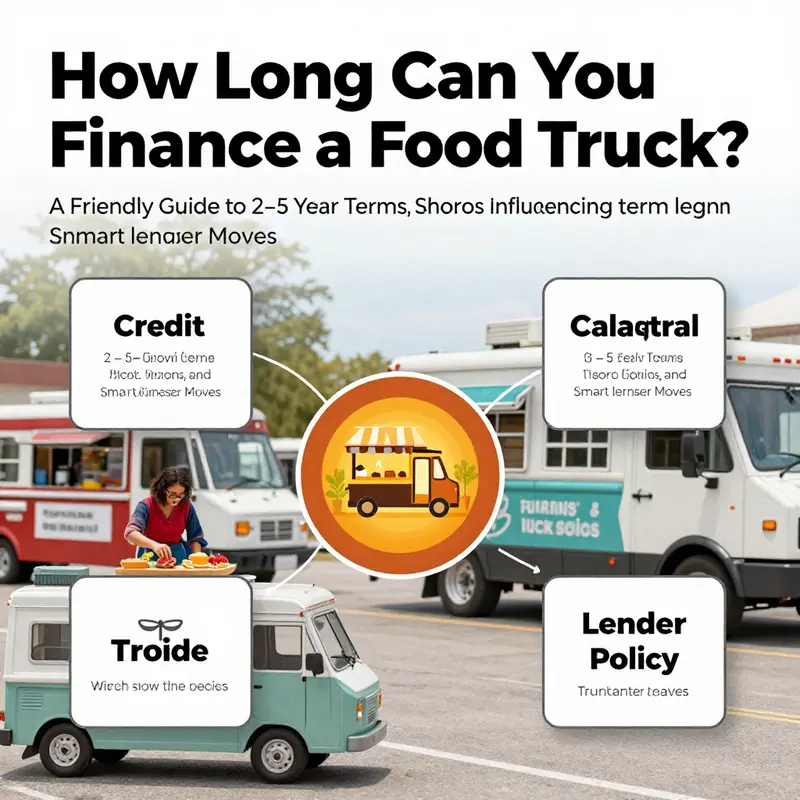
From the broad spectrum of 2–5 year terms to the flexibility of 12–24 month options, plus the core factors lenders consider, you now have a practical framework for planning. For event planners coordinating large or recurring engagements, HR teams supporting pop-up experiences, and community groups fueling vibrant street-food scenes, choosing the right term length hinges on how you’ll generate revenue, how quickly you plan to scale, and the level of risk you’re comfortable with. A secured loan that uses the truck as collateral can offer more favorable rates, while unsecured options may come with higher payments but quicker approvals—especially for startups with compelling business plans. The truck’s age and condition are tangible realities: newer units may qualify for longer terms, while older trucks can lead to shorter windows or higher costs. A well-crafted business plan with a clear forecast of sales, costs, maintenance, and debt service makes you a stronger partner to lenders. Gather financials, map your event calendar, and test terms with banks, credit unions, and specialty equipment lenders to compare fees and protections. With the right mix of terms and a grounded plan, a food truck becomes not just a vehicle, but a scalable platform for communities, workplaces, and food enthusiasts alike.