The Great Food Truck Race (GFTR) serves more than entertainment; it mirrors the pressures and signals that drive mobile food ventures, community events, and team resilience. Elimination moments—whether a harsh episode departure, a voluntary bow-out, or a decisive finale verdict—reveal how teams respond to real-time consumer demand, operational hurdles, and public visibility. This piece centers on who was eliminated and why, using Season 18’s double elimination and Rising Tiger’s self-elimination as a crisp early example, and Season 2’s finale where The Lime Truck secured a milestone sales victory. By examining these moments across seasons, we uncover recurring patterns: public-facing metrics like sales thresholds, the psychology of competition, and how communities perceive and react to teams facing the exit. We’ll then connect these insights to cross-season data sources, and finish with a look at how geography and socioeconomic context shape elimination narratives. Each chapter builds toward a holistic understanding that resonates with event planners, HR teams, local groups, and curious food enthusiasts alike.
Opening Salvo on Wheels: Season 18’s Double Elimination and Rising Tiger’s Self-Withdrawal
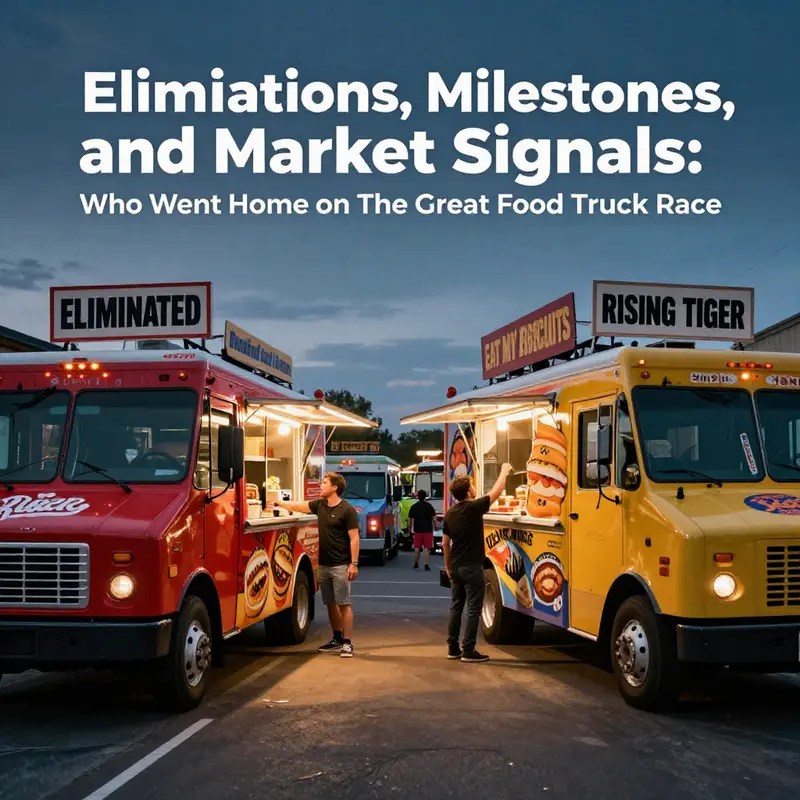
The Great Food Truck Race arranges its battles like a high-stakes road trip where each stop tests more than the menu. It is a competition driven by a mix of street-smart sales, efficient kitchen choreography, and the ability to read a crowd that shifts with every city block. Yet for all the drama of sizzling grills and inventive bites, the real hinge of the show is often the simple, unforgiving math of numbers: sales targets, cash flow, and the speed with which teams convert curiosity into customers. This calculus came into sharp focus at the very start of Season 18, when the premiere delivered a jolt that sent a signal about how brutal and clear the GFTR arena can be. In that first episode, the audience witnessed a double elimination that would set the emotional rhythm for the entire season, a reminder that in a race built on real money and real pace, a misstep can erase weeks of effort in an instant. The two teams at the center of that moment—Eat My Biscuits and Rising Tiger—entered the race with distinct stories and distinct recipes for success, but their fates collided with the same brutal constraint: a minimum sales threshold that determined who would stay and who would go. The moment remains a touchstone for fans and observers who map the show’s eliminations not merely by who failed, but by how the show translates a team’s early performance into a lasting narrative arc. The episode that delivered this shock is documented in trusted recaps, including a widely cited review from Entertainment Weekly that recaps the premiere and frames the double exit against the show’s broader structure. The exact phrasing of the recap emphasizes the surprise and the stakes, underscoring how early rounds can crystallize a season’s themes: pressure, momentum, and the ever-present possibility that a single episode can rewrite a team’s entire plan. For those who want to see the episode’s sequence and the moment-to-moment decisions that led to the eliminations, the EW recap provides a concise, authoritative snapshot of the event. This opening chapter of Season 18 thus becomes an instructive case study for how GFTR’s elimination dynamics work in practice, and it invites readers to consider how early losses translate into the story later on. The linked recap helps anchor the narrative in verifiable detail while the larger arc of the season invites a more interpretive look at what these early departures reveal about the race’s design and its real-world consequences. A broader frame comes from cross-referencing IMDb’s episode guides and the Food Network’s official pages, which together sketch a map of the season’s early volatility and its longer-term trajectories. In short, the first episode didn’t merely remove two teams; it established a tone: in GFTR, beginnings matter deeply, and a debut can carry the weight of a season’s entire emotional economy. The double elimination marks a pivotal moment that invites readers to explore the mechanics behind the numbers as well as the human choices that navigate them.
From there, the narrative turns on two complementary trajectories. Eat My Biscuits entered the episode with a promise many teams carry into the race: a distinctive concept, a clear brand voice, and a desire to translate novelty into repeat customers. Yet in the episode’s brutal arithmetic, their plan clashed with what the show measures most visibly—sales and speed. The precise moments unfold under the lights of a judging framework that rewards not just creative dishes but rapid, repeatable sales. The decision to eliminate Eat My Biscuits in the episode’s closing calculations reflects the show’s reliance on the simplest, most effective metric in the heat of competition: can a team hit or exceed a defined sales target within the constraints of that day’s route, kitchen capacity, and customer appetite? The elimination of Eat My Biscuits is a stark reminder that in this race, a good concept must be backed by reliable, scalable sales performance. It is not enough to offer a delightful bite; the team must also deliver a compelling consumer experience that converts curiosity into dollars, and the premiere’s verdict on Eat My Biscuits makes that mandate visually explicit.
Rising Tiger’s fate, on the other hand, introduces a contrasting but equally important dynamic. Their exit took a different shape and came with a different kind of lesson. Rather than a straight cut tied to sales performance in the moment, Rising Tiger elected to step away from the race after failing to meet the minimum sales threshold. This self-elimination, a rare and conspicuous act in the GFTR canon, foregrounds a layer of strategic calculation that often lurks in the background of competition reality television. When a team chooses to withdraw, it signals a prioritization of longer-term viability over the immediate gravity of the current episode. It is a quiet admission that the financial or logistical costs of continuing might outweigh the potential gains, at least within the constraints of their own plan. The double exit thus becomes a two-pronged lesson about the sport: success can hinge on the discipline to meet explicit sales targets on a given day, and the most agile teams may also decide when the challenge is not worth the burn. Taken together, Eat My Biscuits’ elimination and Rising Tiger’s self-elimination demonstrate two sides of the same coin—the on-air consequences of not meeting the show’s economic and competitive thresholds, and the equally consequential choice to walk away when the math doesn’t add up.
The broader arc of the season, when viewed through the lens of that first episode, reinforces two core patterns that recur across GFTR’s history. First, eliminations are typically tethered to sales performance against targets and to the outcomes of benchmark challenges. The show’s structure relies on objective yardsticks: a predicted revenue benchmark, a set route, a time-limited kitchen, and the pressure of living up to a certain earning goal. Second, there are exceptional cases that reveal the show’s vulnerability to strategic decisions. The self-elimination of Rising Tiger stands out as a rare instance where a team’s calculation about present costs versus future prospects overrides the urge to stay and fight another day. These two patterns—sales-driven eliminations and voluntary departures—together illustrate the winner’s and loser’s economy of GFTR: the contestants must balance ambition, cash flow, and risk, and sometimes the most consequential choices are made away from the public tally of dishes plated and dollars earned.
Historical context helps sharpen these observations. Season 2, a much earlier chapter in the GFTR chronology, culminates not in a mid-episode self-elimination but in a high-stakes final contest between The Lime Truck and Hodge Podge, with The Lime Truck emerging victorious after achieving a notable sales milestone—$15,000 in sales in Miami. This data point, corroborated by IMDb listings and the episode guides, crystallizes a different pace and measurement of success. In that older season, the race rewarded a sustained, high-volume performance across a larger field and a more extended set of challenges, culminating in a final face-off that was less about a single day’s sales threshold and more about cumulative currency, consistency, and the ability to convert attention into sustained profitability through the finale. The contrast between Season 2’s final dynamic and Season 18’s immediate double elimination offers a nuanced view of how GFTR has evolved. It suggests a shift in emphasis from long-run endurance and cumulative revenue toward an intensified emphasis on day-to-day performance and the raw immediacy of a single episode’s numbers. It also hints at how the show’s audience—quick to celebrate a spectacular dish and equally quick to dissect a failing sales run—drives producers to calibrate the show’s risk calculus and its storytelling tempo.
The reliability and interpretation of elimination data depend on a mosaic of sources. The official Food Network page for The Great Food Truck Race furnishes episode guides, air dates, and recap information, providing the primary anchor for the show’s own narrative. IMDb’s all-seasons pages and individual season episode lists offer a community-curated panorama that supplements the official chronology with viewer-driven notes and cross-season patterns. Publicly available recaps from reputable outlets, as in the EW piece referenced earlier, translate those numbers into a coherent storyline that audiences can follow week by week. Taken together, these sources help researchers and fans trace how the race’s dynamics unfold, how the early rounds set expectations for later confrontations, and how a team’s fate is decided in episodes where the math simply does not add up. The discipline of cross-referencing these sources also matters for a fan base hungry for completeness; the synthesis that emerges is robust yet contingent on the currency of data, which is why direct references—formal and informal—appear so frequently in discussions about GFTR’s eliminations.
As a narrative device, the Season 18 premiere’s double elimination also foregrounds a broader ethical and emotional undertone about competition on the truck scale. For teams, the road map of the race becomes a mirror of the real world, where start-up ambitions and cash flow intersect with a marketplace that can be cruel and indifferent to novelty. The show, in this sense, becomes a classroom for the realities of running a mobile business: the need to spark curiosity and capture volume daily, the discipline of maintaining cost controls in an industry sensitive to seasonality and supply, and the courage to admit when a concept, however alluring, is not sustainable within the given constraints. The human dimension—a crew of cooks and organizers who must translate a shared dream into a deliverable product under jet-lag and traffic—adds texture to the raw arithmetic. The Season 18 opening does not merely announce two exits; it invites viewers to witness a microcosm of entrepreneurship under a fluorescent spotlight, where the audience learns to read the signs of viability and the teams learn, sometimes in very public fashion, which strengths to lean on and which weaknesses to shore up.
For readers who want to explore how these early results echo throughout a season, a practical entry point is the LosChifaDoTruck community blog, which gathers reflections on the life cycle of food trucks and the realities of navigating a competitive landscape. A focused read can be found at loschifladostruck blog, which offers perspectives on the economics and strategy of mobile culinary ventures that resonate with the GFTR experience. By following these analyses, readers can connect the episode’s precise outcomes to longer-term questions about branding, pricing, and resilience on the road. The blog serves as a bridge between the on-screen drama and the off-screen considerations that sustain a food truck business, reinforcing the idea that elimination is not merely a moment but a data point that informs future decisions, both on and off the stage of the race. The Season 18 premiere thus becomes a gateway: a dramatic entry into a larger discussion about how teams survive, adapt, and reinvent themselves when the scoreboard is unforgiving and the street still demands a crowd-pleasing plate.
Looking back at that first episode, the combined message is clear. GFTR uses eliminations to test not only taste and technique but also the very capacity to manage a mobile enterprise under pressure. The double exit of Eat My Biscuits and Rising Tiger signals that success in this show requires more than a good idea; it requires the discipline to translate that idea into consistent sales, and the willingness to reassess, reprice, and, when necessary, step away to protect future opportunities. The race is about momentum as much as it is about menus, and early departures often foreshadow the kinds of transformations teams must undertake if they hope to survive the season—and perhaps to thrive beyond the TV screen. As audiences, we watch not only for the next twist but for how the participants will use the knowledge gained from a tough start to recalibrate their approach, either by sharpening their concept, rethinking their pricing, or choosing a path that aligns with their longer-term goals. That is the enduring lesson of the Season 18 premiere: in a world where the clock ticks and the market talks back, the only constant is the need to adapt, measure, and move with intention. External reference: https://www.ew.com/tv/the-great-food-truck-race-season-18-episode-1-recap/
Final Turn on the Coast: How the Lime Truck Sealed Season 2 with a $15,000 Milestone

On the sun-warmed sands that framed the season’s final chapter, The Great Food Truck Race Season 2 marched toward a culmination that was as strategic as it was cinematic. The two teams left standing—the Lime Truck and Hodge Podge—had already proved they could navigate the volatile intersection of appetite, weather, and competition. Yet this finale was not decided by a single heroic service; it was decided by a sustained rhythm of sales, efficiency, and adaptability under pressure. A simple, stubborn benchmark loomed over the entire narrative: reach $15,000 in sales, and you earn the right to compete in the last, beachside duel that would crown the season. The threshold was more than a number. It was a signal that momentum had been built, that a team had learned to translate day-to-day demand into consistent revenue, and that they could translate that revenue into a performance that could withstand the final drive’s scrutiny and fatigue.
The pattern that season laid bare is precisely what has kept the GFTR conversations grounded in recognizable economics as well as spectacle. Sales figures, when they align with clear targets, become a visible proxy for managerial discipline—the ability to schedule, price, and plate with a steady tempo rather than a sprint-and-collapse burst. By the time the final episode rolled in, both Lime Truck and Hodge Podge could point to a body of work that extended beyond a single signature dish or a memorable misstep. They demonstrated, in different flavors, the same fundamental calculus every mobile kitchen faces: maximize throughput without sacrificing quality, keep lines moving without burning out the crew, and sustain customer satisfaction even as crowds swell and the clock tightens.
The Lime Truck’s approach in the finale rested on reliability as much as innovation. Across the season, they had shown a knack for turning casual interest into repeat business, a skill that translates in any busy street corner where a cart sits between hungry pedestrians and the dining choices of a crowded boardwalk. Their team’s execution during peak windows—pressured by competition, weather, and the natural ebbs and flows of a coastal market—displayed a calm efficiency. The crew managed time at the window with a precision that kept queues orderly and orders moving, a small choreography of movement that reduces both wait times and the risk of errors when the pace spikes. Their menu, while flexible enough to respond to day-to-day conditions, leaned into dependable crowd-pleasers—dishes that could be produced quickly, plated attractively, and delivered hot. The emphasis was not solely on novelty but on the practical reliability that turns a one-off visitor into a returning customer during a multi-hour service window. It is the quiet backbone of a season that wants a champion who can outpace rivals not with bursts of brilliance alone, but with a proven ability to sustain performance across a long arc.
Hodge Podge offered a thoughtful counterpoint. Their strategy leaned into a strong sense of identity and a lean, adaptable menu designed to meet the constraints of a shifting beachfront economy. In the GFTR format, where location plus timing can decide who wins and who stumbles, the ability to pivot matters as much as a signature concept. Hodge Podge illustrated how a crew can leverage a tight operation to carve out time and space amid competing carts, turning limited but well-executed offerings into reliable daily pay. This is the other side of the same coin: when a team cannot rely on a constant stream of customers, the temptation to chase a flash of showmanship grows. In contrast, Hodge Podge’s disciplined adaptability showed that in a world where the clock dictates dining rhythms, precision and flexibility can essentialize into durable performance.
The finale’s structure—two teams arriving at the same final threshold and then facing a decisive test on the beach—amplified the strategic tensions that season long had brewed beneath the surface. It also illuminated a deeper narrative about elimination dynamics that GFTR editors and fans watch closely. Elimination on this show is rarely a single moment of truth. It is the sum of several episodes’ decisions: how well a team can translate daily sales into consistent cash flow, how gracefully they recover from a misstep, how quickly they adapt to a new challenge, and how effectively they communicate value to customers in a crowded marketplace. The Season 2 finale crystallized this logic in an emphatic way: a brand’s endurance is measured not by a single sensational service, but by the ongoing story of how well it can perform under pressure over many weeks. The competition rewards not only culinary creativity but the stewardship of a mobile operation that remains coherent when the stakes rise and the calendar narrows.
This dynamic has a broader resonance beyond the viewer’s screen. It speaks to market viability in the real world, where emerging food ventures must translate curiosity into customers and customers into revenue. The $15,000 milestone, in this light, functions as a practical wearable metric: it demonstrates that a team can accumulate meaningful sales within a defined lane, a signal that the concept is scalable and the operation sustainable if replicated under broader conditions. For teams aspiring to enter such a field, the Season 2 finale offers a compact study: the path to robust sales lies in a balance of menu discipline, service speed, and effective use of space and time. It is about knowing when to push for higher volume and when to protect margins through prudent pricing and waste-minimizing processes. It is about learning, week after week, how to convert peak moments into lasting momentum, the way a well-tuned cart converts a seasonal crowd into a reliable source of income.
The broader elimination framework—the way the show uses concrete performance signals to determine who advances and who exits—aligns with the educational impulse behind the competition format. While the Season 18 example later added a dramatic double elimination in Episode 1, and instances of self-elimination remind viewers that teams sometimes weigh calculation against risk, Season 2’s resolution shows a more measured arc: achievement of a shared threshold leads to a direct, final contest. The narrative momentum here is instructive. It reminds contestants and fans alike that real-world culinary entrepreneurship thrives when there is a clear goal, measurable progress toward that goal, and a final opportunity to demonstrate a complete, deliverable capability under pressure. The Lime Truck’s victory, therefore, is not just a win; it is a demonstration of how early, consistent performance builds toward a pinnacle moment under a collective gaze.
If one looks at Season 2 from a data-oriented lens, the achievement of the $15,000 figure by both finalists signals something meaningful about the players who last the longest. It implies a capacity to forecast, plan, and execute in a way that aligns with audience expectations and the show’s own metrics for success. The finale, in that sense, rewards a blend of recipe artistry and the operational craft that keeps a cart profitable in a high-stakes environment. The lessons extend beyond the show’s boundaries. In any mobile kitchen scenario, the core skills—efficient menu design, scalable production, accurate forecasting, and the ability to convert curiosity into sales without compromising quality—translate into practical competitiveness. The Lime Truck’s season-long discipline and the final duel’s measurable outcomes underscore a simple, enduring truth: consistency compounds. On a stage built from a boardwalk’s bustle and a beach’s breeze, that consistency can be the difference between winning a crown and simply being remembered for a strong run.
For readers who want to translate these insights into concrete practice, the chapter also points toward a practical resource that distills the show’s hard-earned lessons into actionable steps. Consider this internal reference for future planning: financial-tips-for-first-time-food-truck-owners. It connects the season’s disciplined approach to budgeting, revenue management, and risk mitigation in a way that is accessible to someone setting up a mobile operation, long after the cameras stop rolling. The aim is to bridge the drama of reality television with the realities of starting and sustaining a food- truck venture, showing that the best shows teach more than entertainment; they reveal patterns that survive the edit and translate into realized growth when put into practice.
The Season 2 finale also invites a comparative note for fans and scholars examining elimination across seasons. The structure demonstrates that while dramatic exits and surprising twists contribute texture to the viewing experience, the core engine of elimination remains anchored in sales performance, operational efficiency, and the capacity to maintain quality across a cumulative campaign. The lime-coloured banner of victory—this season’s champion—was earned through a consistent, disciplined approach that aligned with the show’s own logic: performance over the long haul, and the courage to compete when the spotlight narrows. As viewers, we are reminded that the thrill of the finale rests not only on the spectacle of a final cook-off, but on the quiet, steady courage of teams who make the daily trades that build a season’s narrative into something memorable and instructive.
External sources provide a formal anchor for this chapter’s account. For a definitive season record and the official rationale behind the final outcome, consult the ABC page that chronicles Season 2’s winner and the final challenge. The public record captures the sequence of events, the threshold reached by both finalists, and the championship moment that crowned the season’s arc with clarity and authority.
External source: https://www.abc.com/shows/great-food-truck-race/season-2/winner
Cross-Season Echoes: Elimination Patterns and the Data Behind The Great Food Truck Race
Elimination on The Great Food Truck Race is not a single moment of drama but a through-line that binds dozens of episodes into a single, relentless arc. The show designs its chapters around the depletion of teams under pressure, and the chapters themselves become maps of strategy, chance, and adaptation. Across seasons, the most concrete, widely publicized exits tend to follow a familiar logic: teams depart when sales targets are missed, when a challenge outcome lands a heavy penalty, or when a strategic decision to withdraw is made under financial or competitive duress. What emerges from examining these exits is a pattern-building exercise for readers and viewers alike—a way to translate what looks like chaos into a set of workable clues about how the competition tests more than culinary skill. This is why cross-season analysis matters: it reveals how the same rules apply in different cities, with different audiences, and against a changing field of rivals, all while the clock keeps ticking toward the next elimination that will alter the balance of power on the truck rally circuit. In the earliest, most documented context of the show, seasons unfold with the same core engine: contestants must translate appetite into revenue, and revenue into safety. When that translation falters—whether because the customers aren’t there, or because the menu doesn’t resonate, or because the logistics collapse—the consequence is a march toward the exit. The elimination mechanism keeps the stakes high and the narrative moving, ensuring that success is not a moment but a pattern answered by decisions under growing pressure.
One of the clearest patterns that emerges from cross-season observations is how public-facing metrics shape who leaves—and when. The show operates with explicit benchmarks, whether stated as minimum sales targets, performance on a given challenge, or the weight of customer feedback captured by judges and hosts. These metrics do not just announce a bottom team; they narrate a failure-to-optimize under pressure. A notable instance in recent data is Season 18, where the premiere of the season concluded with a double elimination. In that episode, two teams were sent home, underscoring how quickly the show can tighten the screws when early numbers fail to meet the threshold strain of public visibility. And in a rare departure that highlights the fragility of commitment within the competition, one team chose to self-eliminate after realizing the sales goals or resource conditions were not sustainable. This self-elimination is not merely a dramatic outlier; it is a window into the strategic calculus teams perform when the risk/return calculus—what it costs to stay versus what it would take to exit—becomes overwhelming. The absence of a traditional arc in that moment is itself a signal about the race’s risk landscape: sometimes, survival means recognizing a point of no return and stepping off the course to preserve future options.
Beyond the mechanics of sales and penalties lies a second, equally telling pattern: menu breadth and flavor choice correlate with endurance. Across multiple seasons, teams that rely on a narrow or overly specialized menu tend to falter earlier. The show rewards versatility, not just technique, because the markets it targets are diverse and mercurial. A limited menu can create revenue bottlenecks when a particular item stops selling or a crowd in a given city craves variety, leading to diminished total sales and a weaker bottom line at elimination time. This is not a universal indictment of specialization; rather, it highlights a core truth of the race: adaptability is as crucial as artistry. When teams face a city with unfamiliar tastes or a crowd that prefers novelty, the ability to pivot—adding a new item, adjusting portion sizes, or reworking a recipe on the fly—often translates into improved visibility and higher daily totals. Conversely, teams that struggle to adapt may lose momentum, fall behind competitors, and watch their cumulative scores dip to the floor. The pattern aligns with a broader industry logic as well: menus that balance crowd-pleasing staples with occasional adventurous items tend to withstand shifting consumer tastes and local competition better than those with little breadth or a fixed, narrow appeal.
Logistics matter just as much as menus. The race lives and dies by the efficiency with which a team can navigate supply chains, secure suitable parking locations, and keep equipment functioning under the strain of a demanding service schedule. When a truck’s systems falter—whether due to faulty equipment, inadequate maintenance, or a misread of the optimal selling window in a given venue—revenue slips. A poor location choice can compound the challenge, exposing teams to less foot traffic, higher competition, or unfavorable weather. The cumulative effect is a negative feedback loop: operational hiccups depress sales, sales translate into weaker standings, and weaker standings amplify the pressure to perform perfectly in subsequent rounds. The show’s structure intensifies these pressures by producing a forty-eight to seventy-two hour rhythm of challenges, shopfronts, and reviews. The result is a continuous test of problem-solving under real time, where success depends not just on the chef’s skill, but on the team’s capacity to marshal resources, revise strategy, and stay resilient when things go sideways.
For researchers and readers who want to trace these patterns across seasons, the data becomes a crucial map. The show’s official pages host season-by-season breakdowns, air dates, and recap information that provide the backbone for cross-season comparisons. At the same time, episode-by-episode guides on entertainment databases offer a granular ledger of eliminations, with each exit tied to the episode’s numbers, challenges, and outcomes. Taken together, these sources allow us to corroborate how frequently a bottom position aligns with a decline in sales, how often criticism lands on a team’s presentation or timing, and when external factors like location or equipment issues steer a team toward departure. The synthesis becomes most robust when researchers triangulate: the show’s own site outlines the structure of eliminations and the criteria used; IMDb’s episode guides provide a cross-season record of who left and when; and Rotten Tomatoes and similar venues offer fan-centered verification and commentary that can illuminate why certain exits felt inevitable or surprising to viewers. The convergence of these sources helps construct a narrative that is both data-rich and readable, a map of elimination that readers can follow through the season-by-season twists and turns. In practice, this triangulation means trusting the official page for the rules and the episode order while using IMDb and fan-led guides to confirm the moment of exit and the surrounding context. When we examine Season 18’s premiere, for example, the episode guide confirms a double exit, while the show’s recap notes describe the challenge outcomes that precipitated the departures. In Season 2, the final contest is recorded with a clear milestone—a sales figure that sealed the championship in a pivotal market—again underscoring how revenue metrics anchor the show’s climactic moments. These cross-season anchors allow researchers to test hypotheses about what predicts survival and what signals an early exit.
From a methodological perspective, what makes cross-season analysis powerful is not simply counting who leaves when, but reading the exit as a story about strategy under pressure. Analysts consistently find that teams with stronger pre-show planning—ranging from fleet logistics and branding to menu design and location scouting—tend to survive longer into the competition. Yet the show’s unpredictability remains a constant. Even well-prepared teams can falter if a single service is sabotaged by weather, traffic, or an ill-timed challenge requirement. The elasticity of the elimination rules—where a team can be sent home or, in rarer cases, choose to withdraw—adds a layer of human complexity that numbers alone cannot reveal. This is where narrative and data converge: the exit becomes both a consequence of measurable performance and a decision born of perceived trajectory, risk, and the inkling that continuing might jeopardize long-term prospects outside the race. In that sense, the chapters of The Great Food Truck Race resemble a carefully edited documentary where each exit is a verdict on how well a team integrated culinary craft, market understanding, and operational discipline into a single, mobile enterprise.
For readers seeking to corroborate cross-season patterns with primary sources, the official Food Network page is the most authoritative starting point. There, season-by-season breakdowns, contestant profiles, and behind-the-scenes notes help anchor the narrative in the show’s own framing of eliminations. Equally valuable are entertainment databases like IMDb, which provide episode-by-episode elimination data that can be cross-checked against air dates and recap summaries. The convergence of these resources makes it possible to map a broader trajectory: early-elimination tendencies tied to narrow menus and logistical gaps; mid-season shifts driven by new city environments and audience reception; and late-season survivals anchored in diversified offerings, sharper execution, and clearer market insights. The chapter thus reads as a testimony to how a television competition converts culinary skill into a test of adaptability under the weight of time, money, and public scrutiny.
For readers who want to explore these patterns beyond the show’s own narrativized account, a holistic view can be gained by visiting a broader range of sources, including a focused food-truck-focused blog that reflects on industry realities such as menu design, pricing, and regulatory navigation. In this context, the linked resource offers a complementary perspective on operational resilience that helps situate GFTR’s elimination dynamics within real-world market pressures. Los Chi Flado Truck blog provides actionable context about how operators balance creative vision with the practical demands of scheduling, supply chains, and revenue targets. This link is not a show recap, but it grounds the elimination discussion in the lived experience of food-truck teams who must translate product excellence into sustainable cash flow under strain. For those who want to see how the show’s framework translates into broader industry practices, this internal reference offers a bridge from screen stories to street-level realities, highlighting the kinds of strategic decisions teams face long before they appear on any recap reel.
As the chapters of The Great Food Truck Race accumulate, so too does the body of evidence about what makes teams fail or endure. The cross-season lens reveals the durable truths: a robust, adaptable menu matters; reliable logistics matter just as much; and the ability to interpret market signals—and to act on them quickly—often determines who remains on the road to the finale. Eliminations, then, are not random endings but diagnostic markers. They tell us where the show’s pressures converge: at the intersection of customer demand, price sensitivity, operational discipline, and the nerve to revise a plan under the glare of a televised clock. The data supports what viewers feel in the moment: that the race is less about a single perfect dish and more about a team’s capacity to sustain momentum when every episode redefines the playing field. In that sense, the cross-season elimination patterns are a guidebook to resilience in a high-stakes, low-margin business, a reminder that success depends as much on process as on palate, and that the exit is sometimes the most honest verdict a team can receive on camera. For researchers and fans alike, the ongoing task remains clear: keep tracing the exits, keep reading the numbers, and keep testing what the data says about why some crews leave the road with momentum and others leave it with nothing but a memory of a tasty but fleeting moment on video.
External resource: For a broader, narrative-informing look that aligns with these patterns, see the official show page for The Great Food Truck Race on Food Network, which provides season-by-season breakdowns, air dates, and recap information. https://www.foodnetwork.com/shows/the-great-food-truck-race
Street Scenes and Bottom Lines: Socioeconomic and Geographic Forces Shaping Eliminations on The Great Food Truck Race
Across the arc of The Great Food Truck Race, eliminations are seldom about a single recipe that fails to please a panel of judges. They emerge at the intersection of taste, timing, money, and place. The Season 18 narrative, with its early shocks and sharp real-world lessons, makes this clear: the most publicly visible terminations are tied to numbers that audiences can read, re-read, and compare from episode to episode. In Episode 1 of Season 18, the race opened with a double elimination that underscored how the show translates a mobile kitchen into a moving business metric. Eat My Biscuits and Rising Tiger exited in the premiere, the latter choosing to step away after failing to hit the minimum sales goal. That decision, voluntary yet devastating in its consequence, reveals a core truth about The Great Food Truck Race: survival depends on more than craft; it hinges on the ability to convert fleeting street footfall into reliable revenue in real time, even when the route is unfamiliar and the clock is unforgiving. The moment also signals a broader pattern that runs through the series, season after season: eliminations are as much about the market environment as they are about the teams’ culinary leadersh ip and management acumen.
If we widen the lens beyond the drama of judges’ critiques, the race becomes a study in how place—the geographic and socioeconomic texture of a location—shapes outcomes. Season 18, like other seasons, travels through a tapestry of neighborhoods, downtown cores, and tourist corridors. Each stop brings a different customer mix, a different set of competing food options, and a different set of constraints on operations. Local incomes, spending habits, and access to diverse customer bases have a direct impact on daily sales. In neighborhoods with higher disposable income, traffic can be brisk, but so can competition; in more economically challenged areas, bite-sized purchases and repeat visits might be more fragile in the face of operating costs or inconsistent weather. These dynamics matter even when a team has a strong concept. A truck may offer a sizzling fried entrée or a comforting street staple, yet if the surrounding geography doesn’t support robust demand, the numbers on the board can lag behind expectations. In this way, geography acts as a force multiplier or a constraint, shaping how quickly a team can rebound from a setback, how tightly margins must be controlled, and how aggressively a team must pivot in the course of a few days.
The idea that sales thresholds and mission-critical challenges determine who leaves is consistent across the show’s history. The public-facing metrics—daily sales totals, plating speed, and the ability to meet challenge-driven targets—translate directly into safety nets or handshakes with the exit doors. Yet the episodes of Season 18, and the broader GFTR archive, remind us that the geographic canvas on which teams paint their sales stories can tilt the scales in subtle, systemic ways. A team that thrives in one city can struggle in the next if the new locale carries different customer expectations, greater competition, or more onerous regulatory hurdles. The show’s format intensifies these pressures by compressing time and narrowing options. A truck must learn a new route, adjust its menu for local tastes, and adapt its logistics to unfamiliar streets—all while the clock keeps marching. The economic substratum under each stop—hourly wages, local taxes, parking and permit costs, and the price sensitivity of local diners—acts in a chorus with the episode’s on-camera challenges to determine who endures and who departs.
Season 18’s early elimination episode is a vivid case study in how these external forces play out. The episode highlights the resilience required in the mobile food trade when a team must pivot under pressure, navigate fluctuating customer streams, and manage the pinch of operating costs in real time. In many markets, rents and regulatory fees can rise in tandem with foot traffic, making the business of selling food from a truck a delicate balance of price, volume, and efficiency. A truck operating in a high-foot-traffic urban core may enjoy visibility, but it also faces higher regulatory friction, steeper competition, and elevated baseline costs—factors that can erode margins and magnify even small miscalculations in pricing or portion control. Conversely, a truck that finds footholds in more peripheral or underserved markets may encounter lower overhead, but those advantages can be offset by thinner customer density and limited opportunities for repeat business. The dichotomy between urban magnetism and rural practicality is a recurring tension for GFTR teams, one that can be as consequential as any chef’s technique on the grill.
This interplay of place and price is not merely an academic observation; it informs how teams recover from setbacks and how elimination decisions are shaped. When a team falters, it is not always due to a lack of skill or a deficient recipe. Sometimes the shortfall reflects a mismatch between what a truck offers and the appetite of the local market on a given day, or the way that a particular route aligns with pedestrian flow, event schedules, or transportation patterns. A city with a bustling downtown festival, for instance, can become a turning point where a team with a flexible, high-perceived-value menu and rapid service might surge ahead, while another with a heavier reliance on single-dish comfort food could see sales plateau if crowds drift toward a broader mix of options. The double elimination of Season 18’s Episode 1, and the self-elimination by Rising Tiger, illustrate how a moment of misalignment—between sales targets, location dynamics, and customer readiness to buy—can terminate a team’s journey almost as decisively as a failed dish in a blind tasting.
The argument extends beyond episode-by-episode outcomes to a more nuanced reading of risk and resilience as they play out over a season. In sectors defined by mobility, startups learn quickly that geography is not simply a backdrop but a variable in every business equation. Local income levels, consumption habits, and the velocity of foot traffic create a living map of opportunities and hazards. A team entering a state with a robust midday trade culture may find a ready-made stream of lunch-hour customers. A neighbor city with strong evening economies might deliver consistent demand for late-night offerings. But the same team may confront a completely different picture when moving to a smaller town or a neighborhood with limited access to parking, fewer public transit options, or stricter permit requirements. Each shift in the map reshapes not only sales curves but also strategy—how aggressively to price, how long to stay on a block, when to pivot to a new cuisine, and how to optimize a supply chain that must chase fresh ingredients across a changing urban-rural spectrum.
This structural reading of eliminations invites a broader consideration of who benefits from, and who bears the brunt of, the design of GFTR’s competitive geography. Teams from underrepresented communities or regions with fewer economic opportunities may enter the race carrying a heavier load of structural constraints. They may have more limited access to capital, less preexisting community infrastructure to drive word-of-mouth, or fewer high-volume anchor events to anchor their week-to-week revenue. Such disparities are not mere anecdotes; they emerge in the public data that fans and researchers compile from episode guides, fan wikis, and official recaps. When the show assigns a route through neighborhoods that historically lack sustained mobile-dining ecosystems, the teams’ adaptability is tested in a high-stakes laboratory. A truck that can reframe its value proposition, adjust portion sizes to manage waste, and partner with local events or charities can weather early setbacks more effectively than one that cannot adapt its economic model in real time. The elimination figures, therefore, become a lens for examining how systemic inequalities influence entrepreneurial outcomes in the high-stakes world of a televised culinary race.
The chapter’s focus remains grounded in the real mechanics of competition: how much is sold, at what margin, and under what conditions. It is equally important to acknowledge that the data guiding these observations come from imperfect but invaluable sources. The public record—episodes, recaps, and fan-maintained guides—offers a mosaic rather than a complete ledger. Season 18’s episode-by-episode entries, cross-referenced with the official Food Network pages and IMDb episode guides, provide a composite view of elimination events and the surrounding circumstances. For researchers seeking a consolidated account, the official Food Network recap for Episode 2 of Season 18 helps anchor the analysis in a primary source. You can review that recap here: https://www.foodnetwork.com/shows/the-great-food-truck-race/episode-2-recap-season-18. In addition, the broader literature and episode catalogs referenced by fans and databases illustrate how different markets interact with competition in a way that is not merely anecdotal but part of the show’s evolving narrative of risk and resilience.
To further ground this discussion in practical, more actionable context, consider how external perspectives frame these pressures. A broader framing of these market dynamics can be explored through the discussion on food-truck resilience and the freight market uncertainties that shape frontline ventures. See food-truck-resilience-freight-market-uncertainty for a compact synthesis of how external transport and logistics realities reverberate through everyday operations on wheels. The point is not to simplify the race to a pure economic calculus, but to show how numbers on a scoreboard reflect a complex choreography of place, cost, taste, and speed—one that can determine which team strengthens its grip on the market and which team quietly slips behind.
As the series moves from city to city, the interplay of socioeconomic conditions and geographic realities remains a critical backdrop against which each team writes its arc. The elimination patterns become less about the singular skill of a cook and more about the alignment of a business model with the rhythms of the map. Some episodes reward teams for rapid service and flexible menus that ride the surge of a hungry impromptu crowd; others reward endurance and frugality, where the real victory comes from squeezing value from every ingredient and every staff hour. The Season 18 episode 2 finish, while specifics about the exiting team are not always foregrounded in summaries, embodies the broader truth: in a mobile food economy, success is a moving target, and elimination is a byproduct of the market catching up to the plan.
For readers who want to trace exact elimination events and the episodes in which they occur, official recap resources provide the most reliable anchors. These recaps are complemented by IMDb’s all-seasons pages and episode lists, which help map the arc of each season. Taken together, they form a scaffold for analyzing not just who was eliminated, but why—how the texture of place, the flow of customers, and the economics of running a kitchen on wheels converge to shape a team’s fate. The chapter therefore refuses to isolate elimination as a moment of culinary misfortune; it situates those moments within a larger ecosystem of urban demand, spatial dynamics, and the ongoing negotiation between a truck’s identity and the market it tries to serve.
In the end, the lessons extend beyond a single episode or a single season. The race offers a recurring narrative about entrepreneurship in a setting where geography and socioeconomic realities constantly reframe opportunity. The teams that survive do so not only by cooking well but by listening to the signals of location, by pricing with an eye to variable traffic, and by recalibrating their operations when the map changes. The elimination outcomes are thus a mirror held up to the broader dynamic of street commerce: a reminder that in food, as in many ventures, place matters as much as palate, and the bottom line is in constant dialogue with the places where money is earned and customers are found.
For those seeking a precise, episode-by-episode ledger of who left when, the official recap page and the IMDb episode guides remain indispensable. They provide the corroboration that underpins the broader interpretation offered here and ground the discussion in verifiable facts. The show’s public-facing data, while not a substitute for qualitative interviews or vendor-level financials, offers a compelling narrative through-lines: eliminations driven by sales thresholds, occasionally punctuated by self-elimination when a team weighs strategic or financial considerations against the clock and the course. In the longer view, these patterns reflect the ongoing tension in the mobile food economy between opportunity and constraint, between the energy of a crowded street and the cost of bringing a kitchen to that street day after day.
As the chapters unfold, the next turns in the GFTR map will undoubtedly test new variables: shifts in urban density, changes in consumer mobility patterns, and evolving regulatory landscapes. Each season adds weight to the argument that socioeconomic and geographic contexts are not mere backdrops but active instruments in the competition. The stories of eliminated teams—whether they departed because their sales did not meet a benchmark or because strategic decisions steered them toward a different path—become data points in a larger exploration of how street-food entrepreneurship negotiates place, price, and pace under pressure. The Great Food Truck Race, in this sense, is less a contest of which truck makes the most heat and more a study of how teams translate location into lasting business momentum, and how, in the process, elimination maps a route through a marketplace that is as complex as it is delicious.
External resource for deeper context: https://www.foodnetwork.com/shows/the-great-food-truck-race/episode-2-recap-season-18
Final thoughts
Eliminations on The Great Food Truck Race are more than dramatic TV moments; they are reflections of market signals, team strategy, and community engagement. Season 18’s double exit and Rising Tiger’s self-elimination illustrate how thresholds and voluntary decisions reset the competitive stage. Season 2’s finale highlights a milestone that can redefine a brand’s trajectory. By examining cross-season patterns and reliable data sources, planners and organizers can glean how public metrics, local markets, and audience sentiment drive outcomes. The broader takeaway is practical: design experiences and events that understand where metrics matter, how communities respond, and how teams can pivot gracefully when the spotlight shifts. This blend of competition insight and real-world applicability can inform how you plan, host, or participate in vibrant street-food experiences that celebrate resilience as much as speed.